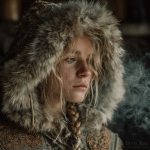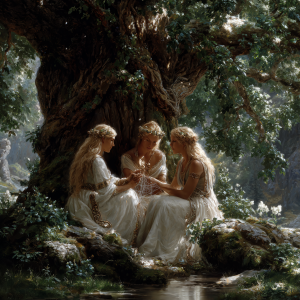
Norse mythology is rich with themes exploring the struggle between chaos and order, and central to these stories is the paradoxical interplay between fate and free will. At the heart of this tension stand the Norns, three female beings who personify fate; Urd, Verdandi, and Skuld. Their name derives from the Old Norse norn, meaning “to become,” capturing their role in determining what unfolds.
Fate often presents itself as an inevitable, predetermined course of events beyond human control. If there exists a grand design, a predetermined script for every living being, then the universe unfolds not randomly, but in a meticulously ordered manner. Determinism stretches this idea further, proposing that every event, every thought, and every action is an inevitable consequence of prior ones. This chain extends back to the dawn of time, creating a web of causality that binds the cosmos. The butterfly’s wings that cause a distant tornado, the falling apple that births a new understanding of gravity – these are but glimpses of determinism at work. Such a universe leaves little room for spontaneity; every tear, every laugh, every heartbeat follows an ancient, cosmic rhythm.
Contrasting this deterministic universe is the luminous beacon of free will. It proposes a world where we are not just passive recipients of fate, but active participants, carving our own destinies with conscious intent. Free will is the song of the soul, the assertion of autonomy. We possess the inherent ability to make choices, untouched by past events. It is the power to act at one’s discretion, a manifestation of true agency. To believe in free will is to believe in the human spirit’s potential to rise, to change, and to shape its journey. It’s the possibility that tomorrow is not a shadow of today but a canvas awaiting our touch.
- Urd – Past: She is often depicted as a wise figure who weaves the threads of fate from the experiences and choices that have already occurred.
- Verdandi – Present: She embodies the ongoing process of becoming and the decisions that are actively being made in the current moment.
- Skuld – Future: She is associated with what is yet to come, including potentialities and the unknown paths that lie ahead.
The Norns dwell at the base of Yggdrasil, the World Tree, where they tend its roots and weave together the fates of both gods and humans. As weavers, they intertwine the threads of past, present, and future and their loom symbolizes the interconnectedness of all events and the way individual actions contribute to the broader tapestry of existence. Their work blends individual determination with divine influence, creating a tapestry in which mortal lives are intertwined.
Yet, despite the overwhelming presence of fate, Norse mythology consistently upholds the importance of self-determination, free-will or choice. Heroes are confronted with decisions that test their courage, loyalty, and character, demonstrating the belief that individuals can meaningfully influence their destinies even while moving within the boundaries set by the Norns. Fate may define the conditions, but how one meets those conditions—bravely, foolishly, selfishly, or nobly—that is left to the human will.
The Norns do not negate free will. Their roles personify the way in which fate provides the framework and human agency fills in the content.
The Hávamál, one of the central texts of the Poetic Edda, affirms this directly. In stanza 23, Odin observes:
“The foolish man lies awake all night,
thinking of all he must choose.
When morning comes he is weary,
and all is as it ever was.”
—Hávamál, stanza 23
Men must choose, and losing sleep over the options leaves one exhausted and with nothing done.