Aimee K
Kingdom Rent
After Saul’s willful disobedience with the Amalekites, the prophet Samuel delivered a sobering message from the Lord:
And Samuel said unto Saul, I will not return with you, for you have rejected the word of the Lord, and the Lord has rejected you from being king over Israel.
Rather than accepting the consequences of his own actions, Saul reacted; seizing the edge of Samuel’s mantle so forcefully that it tore.
And as Samuel turned about to go away, he laid hold upon the skirt of his mantle, and it rent.
Samuel calmly used the rent garment as a visual witness of the judgement and reiterated the Lord’s decision.
The Lord has rent the kingdom of Israel from you this day, and has given it to a neighbor of yours that is better than you.
Normally when garments are rent it is the person wearing them tearing their own clothes out of grief and sorrow. Saul stands alone in scripture as the only recorded figure who, in a moment of anger and desperation, tore a garment that was not his own—a prophetic mantle, no less—attempting to grasp authority even as it was being taken from him.
Something important to keep in mind that if you reject the word of the Lord while occupying an anointed position of great trust, the Lord will reject you.
We tend to think that prophets get the job done and don’t bother themselves with the messy details. That’s not true at all. Samuel was legitimately upset over Saul’s loss.
And the Lord said unto Samuel, How long will you mourn for Saul, seeing I have rejected him from reigning over Israel? Fill your horn with oil and go, I will send you to Jesse the Bethlehemite, for I have provided me a king among his sons.
Sons of Jesse
The Lord did not waste any time sending Samuel out to anoint the next king of Israel. Buck up, ‘lil fella. We’ve got work to do!
When Samuel arrived in Bethlehem the elders of the town trembled, asking “Do you come peaceably?” (1 Sam 16:4) Why were they terrified? Samuel had just shown that he was meek and tenderhearted.
It’s because immediately before sorrowing over Saul, he literally chopped King Agag into pieces (1 Sam. 15:32-33). It wouldn’t have been acting on his own, but with explicit instructions from the Lord to do so. The Lord accompanied Samuel wherever he went (or visa-versa, would probably be more accurate), so naturally the people knew big things were about to happen if Samuel showed up in town.
To assuage their fears Samuel told them he had come to sacrifice with them, inviting Jesse and his sons specifically to participate.
Afterwards Samuel met with Jesse and asked to be introduced to each of his sons.
Jesse’s eldest son Eliab was tall, handsome and met every expectation of what a noble king might look like. And Samuel thought to himself, “Surely the Lord’s anointed is before him.”
But the Lord said unto Samuel, Look not on his countenance or on the height of his stature, because I have refused him; for the Lord sees not as man sees. For man looks on the outward appearance, but the Lord looks on the heart.
1 Sam. 16:6-8
One by one Samuel considered each son and then went onto the next youngest. Surely by now the boys knew something was up.
Not having found the Lord’s choice among those presented he asked Jesse, “Are all your children here?”
Why wasn’t David called in to be considered at the first? Something to think about…
David was called in from the fields where he was tending the sheep.
Now he was ruddy, and of a beautiful countenance, and handsome to look to. And the Lord said, Arise, anoint him, for this is he. Then Samuel took the horn of oil and anointed him in the midst of his brethren, and the spirit of the Lord came upon David from that day forward.
1 Sam. 16:12-13
Meanwhile, the spirit of the Lord departed from Saul and an evil spirit stepped in to take its place. Saul was tormented. Hoping that soothing music might help to comfort their king, Saul’s servants started asking around if anyone knew how to play the harp.
Then answered one of the servants and said, Behold, I have seen a son of Jesse the Bethlehemite that is skilled in playing, and a mighty valiant man, and a man of war, and prudent in matters, and a comely person, and the Lord is with him.
1 Sam. 16:18-20
The irony here is rich. Saul, then tormented by an evil spirit after losing the Lord’s favor, was unknowingly about to be comforted by the very one who had been chosen to replace him.
David was sent for and brought into Saul’s household—not as a warrior or advisor, but as a musician. A shepherd boy with a harp. The future king arrived not to take the throne, but to bring peace to the man who still occupied it.
“And it came to pass, when the evil spirit from God was upon Saul, that David took an harp, and played with his hand: so Saul was refreshed, and was well, and the evil spirit departed from him.”
1 Samuel 16:23
David brought with him something that no armor, no strategy, and no royal decree could summon: the Spirit of the Lord. He didn’t have a title. He didn’t need one. He came into the king’s presence with nothing but his gift and his God—and the darkness fled.
Saul had no idea this was the one the Lord had anointed in his place. He simply knew that when David played, his soul found rest.
This was no accident. It was a quiet act of providence. Before the battle with Goliath, before the songs of praise, before the jealousy and pursuit—Saul and David had this moment. A private peace. A brief but beautiful friendship, built on music, spirit, and healing.
God was not in a hurry. He was laying the groundwork for what was to come.
Ready and Willing
David returned to shepherding his flocks after his time serving in Saul’s house, but the story wasn’t over. War broke out between the Philistines and Israel. The three oldest of Jesse’s eight sons were already part of Saul’s army.
Jesse sent David on an errand to bring his brothers food and cheeses (which would have been a luxury during wartime) for their captains.
And Jesse said unto David his son, Take now for your brethren an ephah of this parched grain and these ten loaves, and run to the camp, to your brethren. And carry these ten cheeses unto the captain of their thousand, and look how your brethren fare, and take their pledge.
David obeyed. He left his sheep with a keeper and made the journey.
When David arrived, the armies of Israel were already arrayed in fear. For forty days, Goliath had come forward—morning and evening—taunting, threatening, defying the armies of the living God. And no one had stepped forward.
David heard it once. That was enough.
He was young, yes—but he was anointed, and filled righteous indignation; with the Spirit of the Lord. This wasn’t just about national pride or military strength. This was an insult against covenant Israel. And David would not stand idly by.
Who is this uncircumcised Philistine, that he should defy the armies of the living God?
1 Samuel 17:26
When David offered to face Goliath, Saul tried to equip him the best way he knew how—with armor, a helmet, a sword. The accoutrements of standard warfare.
But David had never trained wearing those things. He hadn’t tested them and certainly knew that he would be at a deadly disadvantage if he tried.
I cannot go with these; for I have not proved them. And David put them off.
1 Samuel 17:39
He wouldn’t fight Goliath on Goliath’s terms. And he certainly couldn’t wear Saul’s armor to do it. He would face this son of a giant not in human strength, but in the name of the Lord.
Reasoning Together
David’s rejection of Saul’s armor teaches us something vital—not all tools are fit for the battle at hand. There are times when what the world offers, even with the best of intentions, is not just unhelpful—it’s a hindrance.
In the same spirit, I want to take a brief detour to set something up. It’ll make sense, I promise. Just hang with me for a moment.
Man has intelligence and strength. Woman has wisdom and is nurturing. Both require a rational mind in order to effectively reason together. Part of that requires the ability to identify and refrain from using logical fallacies.
Generally people who don’t have an agenda can be persuaded. Being persuasive does not require sound logic. Logical fallacies are the daily fare of nearly all advertising.
Structure and Function of Argument:
Introduction to Critical Thinking
Fallacies of Relevance
Arguments that are really distractions from the main point.
Four Key Questions:
What is the issue at hand?
Relevance → Is the argument relevant to the issue at hand?
Presumption → Is the argument assuming something illegitimate?
Clarity → Is the argument clear
Ad Fontem Arguments
Arguments that distract by focusing attention of the source of the argument, rather than on the issue itself
Ad Hominem abusive insults the opponent with derogatory language. Name calling falls under this category.
Ad Hominem Circumstantial tries to discredit an opponent because of his background, affiliations, or self-interest in the matter at hand.
A common example of this in modern discourse is the abortion debate, where some people argue: “No uterus, no opinion!”
Rather than addressing the ethical or logical points someone might raise about abortion, this response tries to invalidate the person’s voice based on their gender. It doesn’t engage with the argument; it sidesteps it by implying the speaker’s background disqualifies them from participating in the conversation.
Tu Quoque means “You also”. Which is to say the argument of the rival ought to be dismissed because he/she does not always follow it themselves. “Don’t use drugs” ought not be dismissed because the person giving the recommendation tried drugs once or even if they were an addict.
My children and I did a year long study of logic last year in our homeschool and after this lesson they would run around calling “tu quoque” on each other.
“Don’t eat in the living room!”
“Tu Quoue! Tu Quoque!”
Which is kind of ironic, if you think about it, because they were intending to say, “Well, you do that too!” but what they were actually saying is “my argument against your challenge is a logical fallacy”. Baby steps, I guess.
Genetic Fallacy tries to reject the argument of an opponent simply because of its source or origin. An example of this is when people reject things Denver Snuffer has taught because it’s not coming from the sitting president of the LDS church.


Consider This
As I was kneeling beside my bed last night, after a day of contemplating the swirling and salacious trivia that envelops us presently, a thought seemed to externally intrude itself upon my mind. It so took hold of me, that it could not be dismissed, and was left to gestate upon the meaning.
There has been much consternation about why the Snuffers have been seemingly indifferent to – or even enabling of the attempt to render the women’s council, invalid. Many have expressed their disorientation and disillusionment with this “oddity.”
The thought – which seemed to be independent of my own, suggested that we are undergoing a “test;” an “evaluation.” Each of us has, regardless of sincere attempts to break cleanly away from hierarchical leadership, cannot help ourselves from seeing the Snuffers, in at least some respect, as our “leaders.” Perhaps, (because it’s for each soul to determine) the Lord is presenting us with an opportunity to be healed from that. To place our full confidence in Him, with the conviction that He is assuredly, in charge of His people and to BE His people, our trust needs further refining in the fire.
So, the test is, whether we trust that the women who counseled together, abiding wholly within the Lord’s own prescribed form, will be upheld by Him – or whether grievous wolves will be allowed to come in and devour the flock. We either trust that He is in control; to intervene; to protect His Word – or we trust that it is man’s prerogative to intervene.
And perhaps, the Snuffers have been aware of this all along. And perhaps we are in real-time, experiencing a process of sorting.
I, like many of you, have been on the side of “standing up” for those women who have sacrificed to render a genuine and unanimous decision. I have been ready to “fight for the cause.” But I cannot devalue an impression from the Spirit. The Lord only will ever support the Peacemakers. He carries them in the palm of His hand, and they are the ones who carry with them, His attributes.
-Anonymous
25 March 2025
Appeals to Emotion
Arguments that attempt to sway the opinions of people by compelling them to feel emotions such as pity, anger, fear, joy, peer pressure, intimidation, etc.
Ad baculum (Latin for “appeal to the stick”) is a logical fallacy where someone tries to win an argument by using threats, intimidation, or force instead of logic or evidence.
It doesn’t try to prove that an idea is true—it just says: “Believe this—or else.”
“To you it is commanded, […] that you fall down and worship the golden image that Nebuchadnezzar the king has set up! And whoever falls not down and worships shall the same hour be cast into the midst of a burning fiery furnace.”
Daniel 3:4–6
Nebuchadnezzar isn’t saying that the golden image is worthy of worship—he’s just threatening anyone who doesn’t worship it with a fiery death. There’s no logic, no persuasion—just raw coercion.

Ad Verecundiam distracts the listener by attempting to appeal to illegitimate authority, such as a celebrity who has no real expertise relating to the issue or product being promoted.
Miram, Moses’ sister, had her own prophetic experience. Exodus 15:20 calls her a prophetess, and she lead the women in worship after the Red Sea crossing. However she got a little too cocky at some point and criticized her brother for taking a second wife after he had been widowed. I’m not sure if it was the marriage or the ethnicity of the wife that she objected to. In any case, she took liberties.
And Miriam and Aaron spoke against Moses because of the Ethiopian woman whom he had married, for he had married an Ethiopian woman. And they said, Has the Lord indeed spoken only by Moses? Has he not spoken also by us?
Miriam appealed to her own spiritual experience and relationship with God—and her closeness to Moses—to justify stepping into a role or making a judgment that God had not authorized her to take.
And the Lord heard it. […]
And the Lord spoke suddenly unto Moses, and unto Aaron, and unto Miriam, Come out you three unto the tabernacle of the congregation. And they three came out. And the Lord came down in the pillar of the cloud, and stood in the door of the tabernacle, and called Aaron and Miriam; and they both came forth.
And he said, Hear now my words: If there is a prophet among you, I the Lord will make myself known unto him in a vision and will speak unto him in a dream. [If] my servant Moses is not so, who is faithful in all my house[?] With him will I speak mouth to mouth, even plainly, and not in dark speeches. And the similitude of the Lord shall he behold. Why then were you not afraid to speak against my servant Moses?
And the anger of the Lord was kindled against them, and he departed. And the cloud departed from off the tabernacle. And behold, Miriam became leprous, white as snow.

Red Herrings
Arguments that make a more subtle appeal to emotion, but include types of proofs that are irrelevant to the case at hand.
After Cain kills Abel, God confronted him:
And the Lord said unto Cain, Where is Abel your brother? And he said, I know not; am I my brother’s keeper?
Gen. 4:9-15
God asked Cain a direct question about Abel’s whereabouts—a confrontation of Cain’s guilt and responsibility for what he did.
Instead of answering, Cain throws out a philosophical distraction. His question to the Lord was meant to divert attention from the murder—redirecting the focus to a vague question about moral responsibility in general, rather than his personal responsibility in that moment.

Straw Man
When someone misrepresents another person’s position—twists it, oversimplifies it, or exaggerates it—and then argues against the distorted version rather than the actual claim.
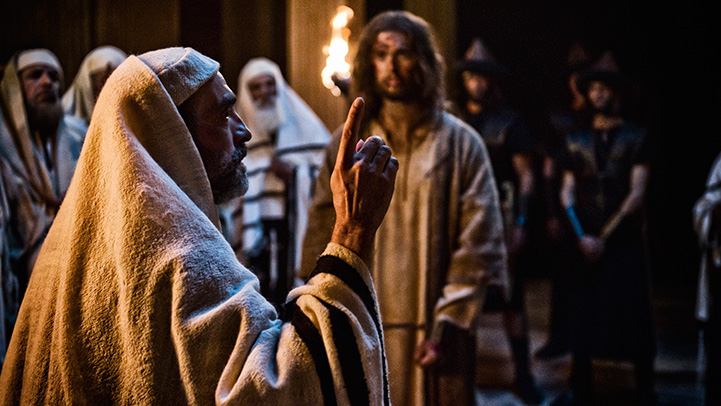
When Jesus was on trial before the Sanhedrin, two false witnesses were brought in:
At the last, came two false witnesses and said, This man said, I am able to destroy the temple of God and to build it in three days.
– Matthew 26:61
What Jesus actually said was:
Destroy this temple and in three days I will raise it up.
John 2:19
He was speaking metaphorically about His body, not planning an act of destruction against the temple. But the straw man accusation twisted His words into something more inflammatory.
False Premise
Arguments built on something that’s assumed but not proven (and often untrue). This belongs under the fallacies of presumption—a unique class dealing with bad starting assumptions. When the foundation is false, then everything built on it becomes vulnerable.
Fallacies in this group include:
- Begging the question (circular reasoning)
- Complex question (loaded question)
- False dilemma (either/or fallacy)
- Hasty generalization
So, rather than being a diversion (like red herring) or an attack on the source (like ad fontem), it’s a faulty foundation fallacy.
Satan says to Jesus:
If you are the Son of God, cast yourself down, for it is written: He shall give his angels charge concerning you, and in their hands they shall bear you up, lest at any time you dash your foot against a stone.
Matthew 4:6
The False Premise:
Premise: “If you’re the Son of God, God will protect you no matter what—even if you do something reckless.”
Flaw: This twists scripture and assumes that God’s protection is unconditional, even in the face of prideful testing.
Conclusion: “Therefore, prove your identity by jumping.”

Addressing Logical Fallacies
Reasoning with the Unreasonable


When we encounter conflict, most of us instinctively reach for the tools of logic, empathy, and dialogue. We assume that if we can just communicate clearly—if we reason together with patience and sincerity—we can come to understanding. That’s because we value truth. We operate in good faith.
But not everyone does.
Predators, like Goliath or Delilah, don’t play by those rules. They are not engaged in a search for truth, as they might claim. You cannot reason with someone who is hellbent on your destruction. You cannot reach mutual understanding when your own words are weaponized against you or when the goalposts are constantly shifting. Logic, in such encounters, is not only ineffective—it becomes another snare in a predator’s game.
This is why the response to a predator must be different. You can’t fight them on their terms or using the tools that would work with any other reasonable person. You must discern the spirit you’re dealing with and choose your ground accordingly.
Before David faced Goliath, Saul offered him his own armor. It was a generous gesture on the surface—armor for protection, a sword for combat, the trappings of warfare as the world understood it. But David couldn’t move in it. It was heavy, unfamiliar, and untested.
And David said unto Saul, I cannot go with these; for I have not proved them. And David put them off him. And he took his staff in his hand, and chose him five smooth stones out of the brook, and put them in a shepherd’s bag which he had, even in a scrip.
1 Samuel 17:39
David didn’t reject the fact that he needed preparation before battle. He simply understood that he could not meet Goliath on conventional terms. He knew the battle wasn’t about strength or strategy—it was about God’s covenant with Israel. It was about faithfulness in the face of something that defied heaven itself.
David knew that the armor offered to him, though well-intended, would only slow him down. It would have disadvantaged him in a fight that the enemy had already rigged.
Instead, he came in the name of the Lord, clothed not in the armor of Saul, but in the whole armor of God. His confidence was in God alone.
Whole Armor of God
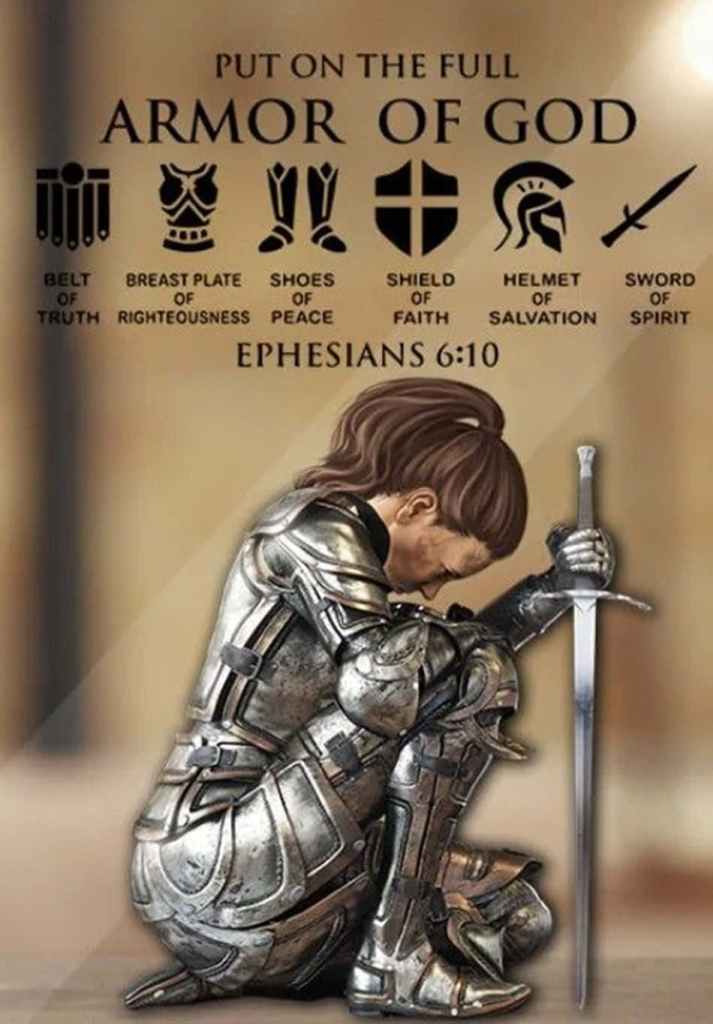
Wherefore, take unto you the whole armor of God, that you may be able to withstand in the evil day, and having done all, to stand. Stand therefore having your loins girded about with truth, and having on the breastplate of righteousness, and your feet shod with the preparation of the gospel of peace — above all, taking the shield of faith, with which you shall be able to quench all the fiery darts of the wicked. And take the helmet of salvation and the sword of the spirit (which is the word of God), praying always, with all prayer and supplication in the spirit, and watching unto that with all perseverance and supplication for all saints, and for me — that utterance may be given unto me, that I may open my mouth boldly to make known the mystery of the gospel for which I am an ambassador in bonds, that therein I may speak boldly, as I ought to speak.
Prepared
David didn’t walk into that valley untested. He wasn’t reckless, naïve, or imprudent in his confidence. He was prepared—and in a way no else could have been.
Thy servant kept his father’s sheep, and there came a lion, and a bear, and took a lamb out of the flock. And I went out after him, and smote him, and delivered it out of his mouth.
1 Samuel 17:34–35
David had faced predators before—real ones, enormous ones with teeth, claws and cunning. He chased them down, fighting alone in the wilderness, in defense of a lamb, and rescued her.

And so, when he looked at Goliath, he didn’t see an unconquerable giant. He saw just another predator threatening the God of Israel’s flock—and David ran toward him.
Then said David to the Philistine, Thou comest to me with a sword, and with a spear, and with a shield: but I come to thee in the name of the Lord of hosts…
1 Samuel 17:45
The Philistine laughed at this unarmed boy mocking him, and expected an easy kill.
And David put his hand in his bag, and took thence a stone, and slang it, and smote the Philistine in his forehead…
It only took one stone, right between the eyes. But if David was so confident why did he pick up five stones? Did you know that Goliath had four brothers?
See 2 Sam. 21:18-22. Now you do.
David was ready to put them all down. And perhaps as a final show of force and deter further challenges he ran forward, picked up the very sword Goliath had intended to kill him with, and used it to end the dispute once and for all.

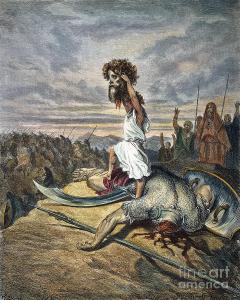
So David prevailed over the Philistine with a sling and with a stone, and smote the Philistine, and slew him. But there was no sword in the hand of David; therefore, David ran and stood upon the Philistine, and took his sword, and drew it out of the sheath thereof, and slew him, and cut off his head with it.
1 Sam. 17:50-51
What followed was chaos. The Philistines fled in terror. The Israelite army surged forward. But the real battle—the one that mattered most—was already over.
David had been prepared long before the conflict began.
Not in the courts of men.
Not with armor or weapons forged on earth.
He was prepared in the hillsides, shepherding his father’s sheep.
And he knew it was really God fighting the battle.


More to the Story
The head of Goliath was buried just outside of Jerusalem and was a significant site because of the victory it represented. It became known as the place of the skull.
And David took the head of the Philistine and brought it to Jerusalem, but he put his armor in his tent.
1 Samuel 17:54
Golgotha doesn’t mean anything close to “skull” in Hebrew, Aramaic, or any other language. The significance of Golgotha would have been well known prior to the Babylonian invasion. Afterward, the name has kept remnants of Goliath of Gath, and even today is known as the place of the skull.
Sword
The sword of Goliath along with his armor was retained by David and likely kept in the treasury; considered a sacred artifact. However, Goliath’s sword was later unsheathed at Nob and turned from sacred trophy into David’s personal sword when he was in need of one before battle.
And the priest said, The sword of Goliath the Philistine whom you slew in the valley of Elah, behold, it is here wrapped in a cloth behind the ephod. If you will take that, take it, for there is no other save that here. And David said, There is none like that. Give it to me.
1 Sam. 21:9 KJV
Battle for Zion
These last few days has felt like the front lines in the battle for Zion itself.
David beat Goliath. But in order for Zion to come we, as a people, must overcome the great mother of abominations. One of her daughters was Delilah, and she corrupted and overcame a covenant man dedicated to God by his mother.
Goliath was beaten by God through David.
Overcoming predatory women who are working to destroy any attempt at Zion while promising they are trying to save it is the work for righteous women.
DAVID CANNOT DO WHAT MUST BE DONE BY ESTHER!
Here’s the thing: If the general body of women vote with a simple majority that 14 women who sat on a council were ALL CORRUPT. God will accept our determination that this attempt to gather a Zion people are CORRUPT. The ratio of righteous to wicked has overwhelmingly been determined to be unsalvageable. Deceivers and abusers of power.
IS THAT REALLY WHAT WE WANT TO SAY?
Zion will come. However, whether we as women will stand united as Huldah, Hannah, Ruth, Deborah, and Esther remains to be seen. If we cannot fight in the ways that these women have done, we have no hope.
Huldah was the prophetess in the college.
Hannah was the mother of the prophet Samuel, who begged God for a child.
Ruth was faithful and stayed by her mother-in-law’s side even in the wake of death when all hope seemed to be lost.
Deborah was a prophetess and judge in Israel.
And like Esther, before she walked into the king’s chambers to her potential death, WE ought to fast together as a community that Israel will be saved and not cut down at this incipient stage.

Airing Dirty Laundry
The-Woman-Who-Has-a-Dispute sounds too much like a character from Harry Potter that I’d rather not evoke. So to avoid the lengthy moniker I will refer to her as Eve.
There was a blog war going on about a year ago within this movement. Eve was posting about it on her blog, Peace-in-Paradise and other people in the movement were responding on their blogs. Denver posted a rebuke on his website and the back and forth stopped. However, it was not before I had cut/paste a beautiful blog-post from Awake-and-Arise-to-Zion as a comment on Peace-in-Paradise’s latest post, which was filled with accusations.
I got an unexpected phone call the morning of March 10th 2024. I didn’t recognize the number so I let it go. The same number called me again that afternoon and left a message.
My account of the interaction is posted below and was recorded on Monday March 11th via a Marco Polo to my friend, with her permission. For privacy, several names have been redacted.
| Date | : Mar 10 2024 03:34:37 PM |
| From | : EVE |
| To | : AIMEE K |
“Hi Aimee this is [EVE] and you left your number so I was just calling you back. My number is [redacted]. Thanks bye bye.
Many women I know who attended the first Women’s Conference Zoom meeting said they left feeling frustrated, exhausted, saying that the meeting was a mess of discord and disorder. I emailed Stephanie with my concerns and she responded back with kindness and understanding saying, “I suspect out of the 85 women who were in attendance, we all experienced something a little different. It is my prayer that if they attend next time, they will have a different experience. “
A dear friend reached out to me asking if I wouldn’t be willing to just listen to the recording. I considered the wisdom and decided to take her counsel.
I have not had any interaction with Eve since our March 2024 phone call until I submitted for registration from the Conference Organizers along with some requests that would accommodate women, like myself, the ability to participate and vote from home.
Eve responded to me by sending out a letter to all those who had registered to address some of the concerns I brought up.
It was considerate and reflected genuine interest in the well-being of all the women. I responded to her this morning:
Eve,
Stephanie,
I meant every word.
I realized something for the first time today. Sometime between April 14, 2023 and the end of that year Eve watched a film called Nefarious, which is a dark movie about demonic possession. She shared with her readers how afterward she found herself engaging with a dark entity that she said was Satan. We know that Satan is a title, and means accuser. I don’t know that it was Lucifer himself, but she recognized the presence as something of the demonic sort.
She gave it a new name, “Paco”; thinking that it would make it mad. But mothers give new names, don’t they? I don’t think Eve knew what she was doing when she did this. There are laws that bind devils and angels. It is our agency that invites either in.
She built a relationship with this devil and thought she was tormenting it with humor. She probably felt smarter or stronger than the entity, but demons are predatory. They know how to appeal to our pride.
There is a real possibility that Eve unwittingly invited this demon in with her attention and let her house be overrun. Of course she would be blind to what happened. This sweet grandmother and mother who plays the piano, takes walks in nature, plays games with her children, crochets amigurumi toys for her grandchildren and has organized beautiful and uplifting conferences in the past, is now accusing 14 women of being unanimously wicked and abusing the laws of God. We ought to recognize the source of all accusation. It comes from Satan. Rather than revile and consider casting her out, we ought to be praying that GOD casts this demon spirit of Satan out of her.
…for we wrestle not against flesh and blood, but against principalities, against powers, against the rulers of the darkness of this world, against spiritual wickedness in high places. Wherefore, take unto you the whole armor of God, that you may be able to withstand in the evil day, and having done all, to stand.
Ephesians 6:12
The timing (10 Feb 2024) of her post titled “A Nefarious Demon aka Paco” coincides with the accusations against the women’s council. If this dark theory is indeed the case, please pray for our covenant sister. She might need God’s rescue more than we realize. Just like the little lamb who was stolen out of the flock by the bear. She was in the mouth of this predatory bear, ready to be devoured, but David gave chase and killed it …with a stone and his sling.
Preparing the Peacemakers
05:30 PM to 06:30 PM MOUNTAIN Time (US and Canada)
DATES:
Firm Boundaries: 23 March 2025
God Heals Our Pain: 30 March 2025
Reclaim Your Power: 06 April 2025
Recordings posted below
Series: Sons of Giants, Sons of Men, Son of God