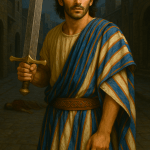

Aimee K
The hubris of certainty from the vantage point of religious belief is a dangerous thing.
Too comfortable in the blessings, peace and prosperity. Given false confidence in the echo chambers…occupied by those we respect, love and revere. No hair out of place. The virtues signaled. The boxes all checked.
“We want to hear smooth things. We want stories that tell us we are good people in a good place doing good things and getting better every day. We want to feel reassured.” Preserving the Restoration p. 239
Objective reality
I asked ChatGPT to create an image that represents objective truth and reality.
It gave me the featured image at the top of this blogpost and the following message:
Here is an image representing objective truth and reality, featuring a crystal-clear mirror lake, a glowing pillar of light, and floating geometric shapes symbolizing logic and structure. Let me know if you’d like any modifications!
Something that I found terribly ironic was the background: a blue sky, reflected also in the bottom half of the image. Truth and objective reality may be as obvious as the sky is blue, and so that detail was omitted from the written description. When questioned about this, ChatGPT responded:
My mind likely filled in the color of the sky as an unstated assumption, which is common when we perceive something as “self-evident.”

Strawman
There is a faith building story retold in institutional lesson manuals regarding Joseph F. Smith, son of Mary Fielding and Hyrum Smith. A band of rough men on horseback were looking to pick a fight with any members of the church they could find. The leader swore he would kill anyone who was a Mormon. Confronting their party and leveling his gun at Joseph F. Smith the leader asked him if he was a Mormon. The young returned missionary responded, “Yes, siree, dyed-in-the-wool; true blue, through and through.” What courage!
Being known as a “true blue” Mormon is a badge of honor. Declaring your faith even in the face of death, persecution, or ostracism. Perhaps this “True Blue” moniker is why BYU’s colors are Blue and White.
Unfortunately a recent YouTube video by Rob Fotheringham laid out journal evidence that Joseph F. Smith had a very different character than the one curated in official lesson manuals.
You can’t tell me that the sky is green when I have seen that it is blue with my own eyes!
I had someone accuse me of this quite recently in an online conversation. It’s a metaphorical straw-man. I hadn’t said anything about colors or the sky. However the underlying message was that I was telling obvious lies in the face of objective reality.
What did I actually say?
The church is in a state of apostasy.
Obviously! But not my church….
[..insert hard eye roll…]
They are all wrong. All their creeds are an abomination in his sight, that those professors were all corrupt, that, They draw near with their lips, but their hearts are far from Him; they teach for doctrines the commandments of men, having a form of godliness, but they deny the power thereof.
Perspective
Staying within the context of the metaphor…
That the sky is blue, that is true enough given the right season, time of day and weather. But it is also regularly grey, red & orange, and also black. You’ve seen all of these manifestations with some regularity.
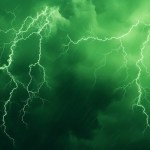
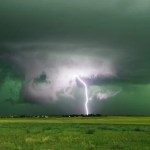
After a little bit of research I discovered that it is, in fact, possible for the sky to be green. Right before a hurricane, or under the unique dancing northern lights of the aurora borealis.

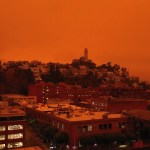




















A sky that is yellow is often and briefly seen at sunrise and sunset. Sandstorms can cause a yellow sky or some degree of pollution like from a fire or volcanic eruption.
Orange skies vividly and briefly appear at sunrise and sunset, but persist when the smoke from nearby fires is thick.
Red skies at sunset suggest that the clouds are filled with dust and moisture. The Tyndall effect explains why places that have a higher level of pollution have more vibrant red sky at sunset.
Rayleigh scattering actually explains all of the colors painted in the sky. After a storm, the large amounts of water vapor and different types of aerosols in the air can make it so only reddish wavelengths of light reach us. If the sun is positioned just right in the sky, it may make it look like the entire sky is bathed in a pinkish glow. And if you put this pinkish glow right in front of a dark blue sky, it creates the dramatic purple skies.
Grey and white skies are as common as the next winter fog rolling in.
Black skies are arguably the most common, more so than even blue skies. They are observed every night and during the day during an eclipse. Whereas blue skies really depend on clear weather mid day.
Skies appear blue because the shorter blue light wavelengths get trapped in the planet’s atmosphere. The white light, with which we are so familiar, is actually the combination of three lights: red, blue and green. The longer green and blue light come through the atmosphere combining to make the sun look yellow. Without an atmosphere the sky would look black during the day, and the sun would appear white. Our atmosphere capturing the shorter wavelength light has the effect of brightening everything up at once. I rather prefer it.
If one were to see a green sky, either you have made the journey specifically seeking these unique lights OR there is a rare but tremendous storm nearly upon you.
Passing through a spiritual awakening is not for the faint of heart.
Narrative Bias
There are millions of Christians the world over that read the account of the New Testament from the perspective of the faithful, persecuted saints and identify with them. We walk with Peter on the water. We are in the inner circle learning at Jesus’ feet. Walking dusty trails. Weeping at the foot of the cross. Rejoicing on Resurrection morning.
Presentism bias is the tendency to interpret the past through a modern lens with it’s greater knowledge and perspective. We assume we would have held the morally right position with the advantage of perfect hindsight.
We naturally align ourselves with the the hero of the story, assuming that we too would have acted courageously when facing giants. This moral projection ignores the risks and social pressures that would have certainly influenced our own actions.
This cognitive bias reinforces a flattering but often inaccurate self-image. Recognizing it can help us both engage with history more honestly and critically, but consider our present condition with a bit more discernment.
With the recent popularity of the musical Wicked since it’s release and expansion in movie form, I’ve had a metaphor in which to discuss false prophets with my children.
Metaphors and parables are so much easier on the tender hearts of those we love. Truth is able to sneak through the stone walls erected by false beliefs and weave a safety net for a conceivable fall.
Who did they call “wicked”?
Elphaba
Was she actually the bad guy?
No, the Wizard was.
Why was the Wizard bad?
He wasn’t a real wizard. He was only pretending.
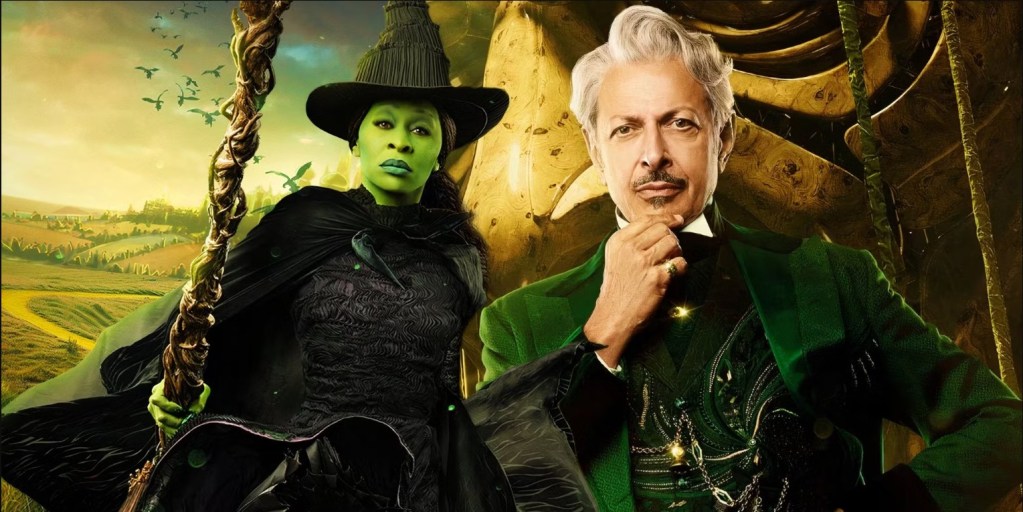
The reality is that the majority of faithful institutional church members (pick your denomination) are munchkins with unquestioning loyalty to the authority of the Wizard with belief in illusions of power. False narratives are used to maintain control. If YOU, like Elphaba, challenge the rule of the Wizard, you will be painted as a dangerous enemy.
The Wizard’s leadership was built in deception and exploitation. He was able to maintain a cult-like devotion even when his actual policies harmed the people who supported him.
The reality is that the Wizard is just a normal man in a seat of power with unique authority and undeserved adoration.
A real wizard has power to do actual magic. Just because the Wizard of Oz was a pretender doesn’t mean there aren’t real wizards. They just won’t look like you think they should. They might even be… green. Like Elphaba.
Find the lost. Call the sinners.
You’re staying in the boat. You’ve not wandered away from the sheepfold. You did not waste your inheritance.
And when the Pharisees saw them, they said unto his disciples, Why does your master eat with publicans and sinners? But when Jesus heard them, he said unto them, They that are whole need not a physician, but they that are sick. But go and learn what this means: I desire mercy, and not sacrifice. For I am not come to call the righteous, but sinners to repentance.
Matt. 9:9-13
Christ answered the Pharisees’ question in a satisfactory way. However, a reality check is that we are all sinners.
“If we say that we have no sin, we deceive ourselves” 1 John 1:8.
So it was an ironic answer in many ways. He ate with the publicans and sinners because they invited Him in. They, sinners, recognized that they needed Him and they wanted to listen. They wanted His company.
As for the Pharisees, people were clamoring to hobnob with them; the ecclesiastical elite. They were used to being desired. Sought after. Honored. Jesus didn’t ever call them righteous; they assumed it about themselves. And plenty of people were willing to reiterate that falsehood. The conclusion remained the same: They didn’t need to be called to repentance, obviously.
However, when these same Pharisees brought the woman taken in adultery to Jesus attempting to trap him, His answer, requiring honest introspection, put them in check.
He that is without sin among you, let him first cast a stone at her. And again he stooped down and wrote on the ground. And they who heard it, being convicted by their own conscience, went out one by one, beginning at the eldest, even unto the last.
John 8:2-9
When it came right down to it, even the scribes and Pharisees recognized that they were not without sin. However, that fleeting realization wasn’t enough to seek salvation when He was there before them. They were entrapped in tradition as evidenced by the order of seniority in which they left the room.
Of themselves they said,
[…] We ourselves are righteous and need not that any man should teach us. God, we know, heard Moses and some of the prophets, but us he will not hear. And they will say, We have the law for our salvation and that is sufficient for us.
Matt. 7:9
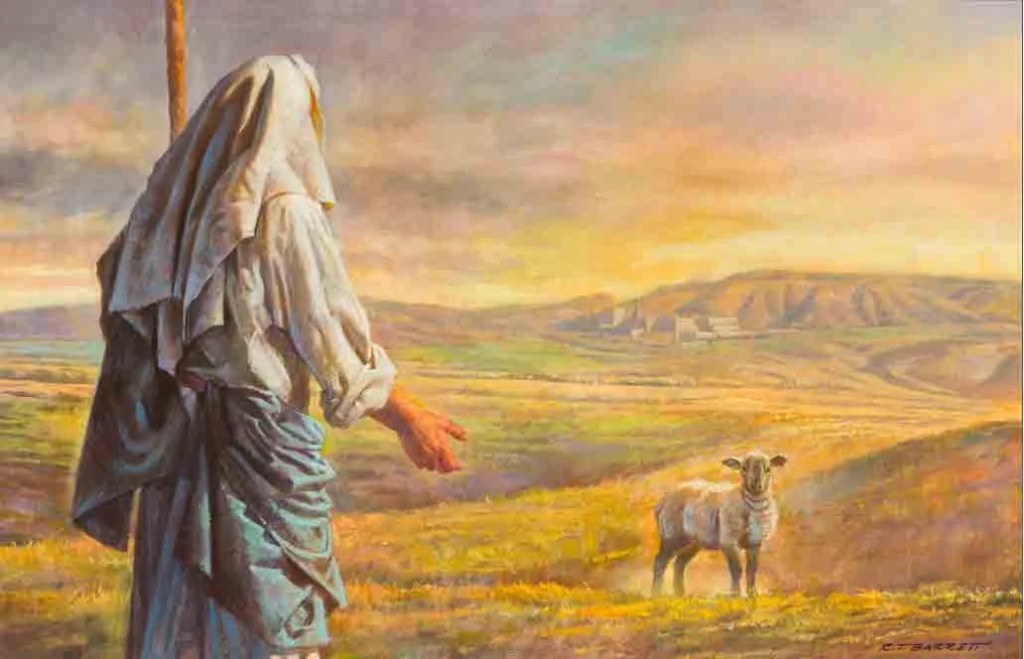
People don’t realize that the condition of the Pharisees were much like the hundred sheep of Christ’s parable. Comfortably situated in the safety of the institution. Centuries of tradition. The rites and observances established by Moses. Gathered comfortably into the sheepfold.
Joseph Smith gave us more insight on this parable.
The hundred sheep represent one—— hundred Saducees and Pharisees, as though Jesus had said. If you Saducees and Pharisees are in the Sheepfold, I have no mission for you, I am sent to look up Sheep that are lost, and when I have found them I will back them up and make joy in heaven. This represents hunting after a few individuals or one poor publican, which the Pharisees and Saducees despised— He also gave them the parable of the Woman and her ten pieces of Silver and how she lost one, and searching diligently found it again, which gave more joy among the friends and neighbors than the nine which were not lost. like I say unto you there is joy in the presence of the Angels of God over one Sinner that repenteth more than over ninety and nine just persons that are so righteous, they will be dam’d anyhow, you cannot save them. [12 lines blank] [HC 5:262] [p. 1459]
It really ought to have been more obvious, because immediately after the parable of the lost sheep He gave us the parable of the lost silver and then the prodigal son. They were not three parables, but one.
The lost sheep is told from the perspective of the Good Shepherd. The lost Silver is told from the perspective of, if I may, Wisdom (Proverbs 2:4-5). And the prodigal son is told from the perspective of the lost soul, who came to himself and turned toward home.
The humbled prodigal had to realize he had sinned and was lost. The Shepherd finds the lost sheep. In the bookends of these parables, there is a degree of agency and action on the part of both the lost and the seeking. But the woman alone accounts for each one of her silver coins, much like a mother can account for her each of her precious children who have no self awareness in themselves.

On the Altar
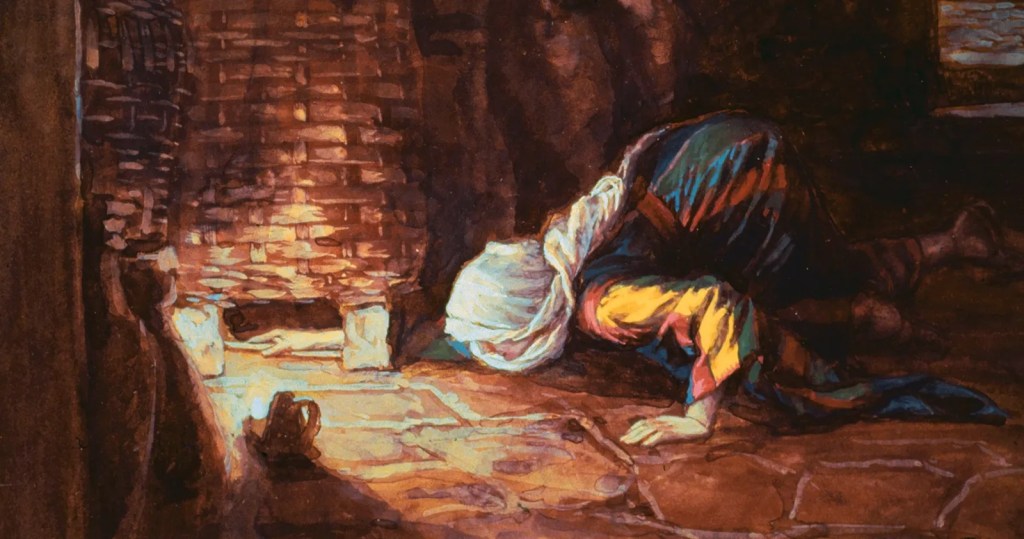
After the great and last sacrifice of our Lord, the sacrifice we are now asked to give is that of a broken heart and contrite spirit. We must recognize that we are broken, lost and in desperate need of rescue.
A connection that I learned recently is that when we fast, we enter a state called ketosis where fat is being burned for energy. Anciently the priests burned fat upon the altar of the temple.
Do you not know that you are the temple of God, and that the spirit of God dwells in you? If any man defile the temple of God, him shall God destroy. For the temple of God is holy, which temple you are.
1 Cor. 3:16-17
Something to consider…
Why do you have to be afflicted by prayer and fasting, if you’re a follower of the Lord, in order to get to the point you can accomplish this? Because you don’t fall prostate, crying out with tears from a broken heart and a contrite spirit. […]
The defect does not consist in the absence of faith in the Lord. The defect is the arrogance and hardness of the heart that prevents you from crying out, in the realistic and anguish of your heart, looking to God who is trying to bring you to Him. That depth of humility, that status of being someone who is utterly harmless, that condition in which you present no threat to the righteous, you are harmless as a
dove, and you seek only the betterment of others.
God can work with those who are broken. Seeds can be planted in broken earth.
Sometimes the sky is...
The LDS people point to the practice of infant baptism as easy evidence of the Catholic apostasy. I just as easily point to the changes of the sacrament ordinance as evidence of the LDS apostasy.
Christ turned water into wine at the marriage in Cana. The LDS church has turned wine into water in the words of the sacrament prayer. No, it doesn’t matter the emblems that we eat and drink. You could use twinkies and diet coke, see D&C 27:1-2. But it does matter the exactness of the words of the ordinance (Isaiah 24:5).
So, going back to Joseph’s original question. Which church is true?
There are only two churches: one is the congregation of the Lamb of God and the other is the church of the accuser. Therefore anyone who doesn’t belong to the congregation of the Lamb of God belongs to the other wealthy and corrupt church that is the mother of abominations, and she is the whore of the whole earth.
1 Ne. 14:8-10
Organized religion and institutional churches are corrupt. ALL. OF. THEM. They are led by wizards who use smoke and mirrors to confuse reality.
“Where can I turn for peace?” To God. And to Him alone.
If you doubt your doubts before you doubt your faith, let me reassure you: Truth can withstand scrutiny. And if you watch carefully, you will see the sky isn’t always blue.