SIGNATURE SERIES: Study In Goodness, Nature, Archetypes, & Truth; Unveiling Righteousness & Eternity
Read this first: Fundamental Truths in Fairy Tales, Fables, and Legends
Themes: Cover sins vs cloak of charity
Source: Red Fairy Book, Germany (Golden Hood), Blue Fairy Book, France (Red Hood)
LITTLE RED RIDING HOOD
I
Once upon a time there lived in a certain village a little country girl, the prettiest creature was ever seen. Her mother was excessively fond of her; and her grandmother doted on her still more. This good woman had made for her a little red riding-hood; which became the girl so extremely well that everybody called her Little Red Riding-Hood.
One day her mother, having made some custards, said to her:
“Go, my dear, and see how thy grandmamma does, for I hear she has been very ill; carry her a custard, and this little pot of butter.”
Little Red Riding-Hood set out immediately to go to her grandmother, who lived in another village.
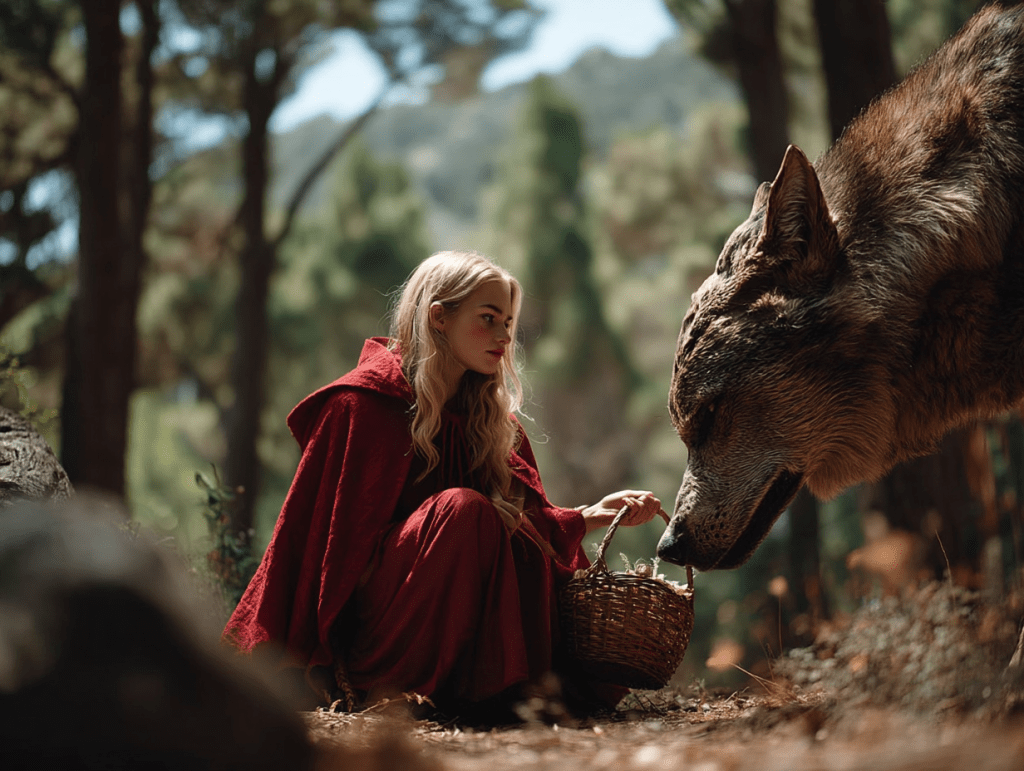
As she was going through the wood, she met with Gaffer Wolf, who had a very great mind to eat her up, but he dared not, because of some faggot-makers hard by in the forest. He asked her whither she was going. The poor child, who did not know that it was dangerous to stay and hear a wolf talk, said to him:
“I am going to see my grandmamma and carry her a custard and a little pot of butter from my mamma.”
“Does she live far off?” said the Wolf.
“Oh! ay,” answered Little Red Riding-Hood; “it is beyond that mill you see there, at the first house in the village.”
“Well,” said the Wolf, “and I’ll go and see her too. I’ll go this way and you go that, and we shall see who will be there soonest.”
In medieval symbolism scarlet had a very specific meaning, representing sin, sexual temptation, or blood guilt. The girl being known only by her red cloak may symbolize an identity defined by entirely by sin, at least from the audience’s perspective.
I am going to start this analysis by making a few fundamental assumptions: Little Red Riding Hood’s cloak is symbolic of both sin and the natural man’s instinct and/or attempt to cover sin.
Your hands are full of blood. Wash yourself, make yourself clean; put away the evil of your doings from before my eyes. Cease to do evil, learn to do well. Seek judgment, relieve the oppressed, judge the fatherless, plead for the widow. Come now and let us reason together, says the Lord. Though your sins be as scarlet…
And the woman was arrayed in purple and scarlet color, and adorned with gold, and precious stones, and pearls, having a golden cup in her hand, full of abominations and filthiness of her fornication.
—Rev. 17:1-6
…but when we undertake to cover our sins or to gratify our pride, our vain ambition, or to exercise control, or dominion, or compulsion, upon the souls of the children of men in any degree of unrighteousness, behold, the Heavens withdraw themselves, the spirit of the Lord is grieved…
—D&C 121:37
Faggot
In older English “faggots” meant bundles of sticks used as firewood. A faggot-maker was simply a woodcutter gathering bundles of sticks. Symbolically this can mean witnesses or restraining forces are preventing an earlier attack. Historically, evil often acts only when unobserved and then may be perpetuated if is without scrutiny.
Men loved darkness rather than light, because their deeds were evil.
Every one that doeth evil hateth the light.
— John 3:19-20
Emblematic of this from 1550s, faggots were especially used for burning heretics, and the phrase “fire and faggot” was used to indicate punishment of a heretic. Heretics who recanted were required to wear an embroidered figure of a faggot on the sleeve as an emblem and reminder of what they deserved.
So, in another sense Little Red Riding Hood could be avoiding earthly punishment by covering her sin, however that invites the advances of the wolf at a later, more vulnerable, time.
…the Devil, as a roaring lion, walks about seeking whom he may devour…
II
The Wolf began to run as fast as he could, taking the nearest way, and the little girl went by that farthest about, diverting herself in gathering nuts, running after butterflies, and making nosegays of such little flowers as she met with. The Wolf was not long before he got to the old woman’s house. He knocked at the door—tap, tap.
“Who’s there?”
“Your grandchild, Little Red Riding-Hood,” replied the Wolf, counterfeiting her voice; “who has brought you a custard and a little pot of butter sent you by mamma.”
The good grandmother, who was in bed, because she was somewhat ill, cried out:
“Pull the bobbin, and the latch will go up.”
The Wolf pulled the bobbin, and the door opened, and then presently he fell upon the good woman and ate her up in a moment, for it was above three days that he had not touched a bit.
Wolf
In older English and French rural speech, “gaffer” was a title for an old man, similar to grandfather, sir, or old fellow. It appears in many early folk tales. Gaffer Wolf essentially means: “Old Master Wolf.”
This symbolism suggests the wolf is not merely a predatory animal since he given both title and deference as would an elder with authority or social standing.
This is consistent with scriptural warnings about predatory authority figures.
And again, beware of false prophets that come to you in sheep’s clothing, but inwardly they are ravening wolves. You shall know them by their fruits. For do men gather grapes of thorns? Or figs of thistles? Even so, every good tree brings forth good fruit, but a corrupt tree brings forth evil fruit. A good tree cannot bring forth evil fruit, neither a corrupt tree bring forth good fruit. Every tree that brings not forth good fruit is hewn down and cast into the fire. Wherefore, by their fruits you shall know them.

III
He then shut the door and went into the grandmother’s bed, expecting Little Red Riding-Hood, who came some time afterward and knocked at the door—tap, tap.
“Who’s there?”
Little Red Riding-Hood, hearing the big voice of the Wolf, was at first afraid; but believing her grandmother had got a cold and was hoarse, answered:
“‘Tis your grandchild, Little Red Riding-Hood, who has brought you a custard and a little pot of butter mamma sends you.”
The Wolf cried out to her, softening his voice as much as he could:
“Pull the bobbin, and the latch will go up.”
Little Red Riding-Hood pulled the bobbin, and the door opened.
The Wolf, seeing her come in, said to her, hiding himself under the bed-clothes:
“Put the custard and the little pot of butter upon the stool, and come and lie down with me.”
Little Red Riding-Hood undressed herself and went into bed, where, being greatly amazed to see how her grandmother looked in her night-clothes, she said to her:
“Grandmamma, what great arms you have got!”
“That is the better to hug thee, my dear.”
“Grandmamma, what great legs you have got!”
“That is to run the better, my child.”
“Grandmamma, what great ears you have got!”
“That is to hear the better, my child.”
“Grandmamma, what great eyes you have got!”
“It is to see the better, my child.”
“Grandmamma, what great teeth you have got!”
“That is to eat thee up.”
And, saying these words, this wicked wolf fell upon Little Red Riding-Hood, and ate her all up.
Discernment
The famous dialogue: What big eyes you have…What big ears you have…What big teeth you have… The foolish girl senses something is wrong but she still accepts the explanation without using any discernment.
Beloved, believe not every spirit, but try the spirits — whether they are of God — because many false prophets are gone out into the world.
— First Epistle of John 4:1
She observes the signs but does not act accordingly. Why? Could it be because effort has instead been diverted to cover the sin. If she is operating in the “economy of darkness”, she is subject to it’s legalities and trade.
We lie down in our shame and our confusion covers us, for we have sinned against the Lord our God, we and our fathers, from our youth even unto this day, and have not obeyed the voice of the Lord our God.
Why the bed?
The bed in early European folklore carries much deeper symbolism than modern readers usually recognize. In a pre-industrial culture, the bed was not merely a place to sleep—it was the central space of vulnerability, intimacy, illness, birth, and death. So when the wolf waits in the bed, the story is placing the confrontation at the most defenseless point of human life.
In the original version of this fairy tale the wolf simply eats her. There is no rescue nor redemption.
Consumption in such story-form often symbolizes total domination; swallowing the victim completely into the predator’s control, which death provides fuel for further acts of violence and wickedness.
For a child growing up in a loving and peaceful household, being eaten is the most fearful thing they can imagine.
There is no obvious lesson, except that children could immediately point out the girl’s mistakes:
- Don’t talk to strangers
- Gut instincts are red flags that ought not be ignored
- Use keen discernment
It’s not until you juxtapose this fairy tale against it’s sister story that a clear difference emerges. Both girls talked to the wolf in the woods. Both girls asked the wolf questions at grandmother’s house.

THE TRUE HISTORY OF LITTLE GOLDEN HOOD
I
You know the tale of poor Little Red Riding-hood, that the Wolf deceived and devoured, with her cake, her little butter can, and her Grandmother; well, the true story happened quite differently, as we know now. And first of all the little girl was called and is still called Little Golden-hood; secondly, it was not she, nor the good grand-dame, but the wicked Wolf who was, in the end, caught and devoured.
Only listen.
The story begins something like the tale.
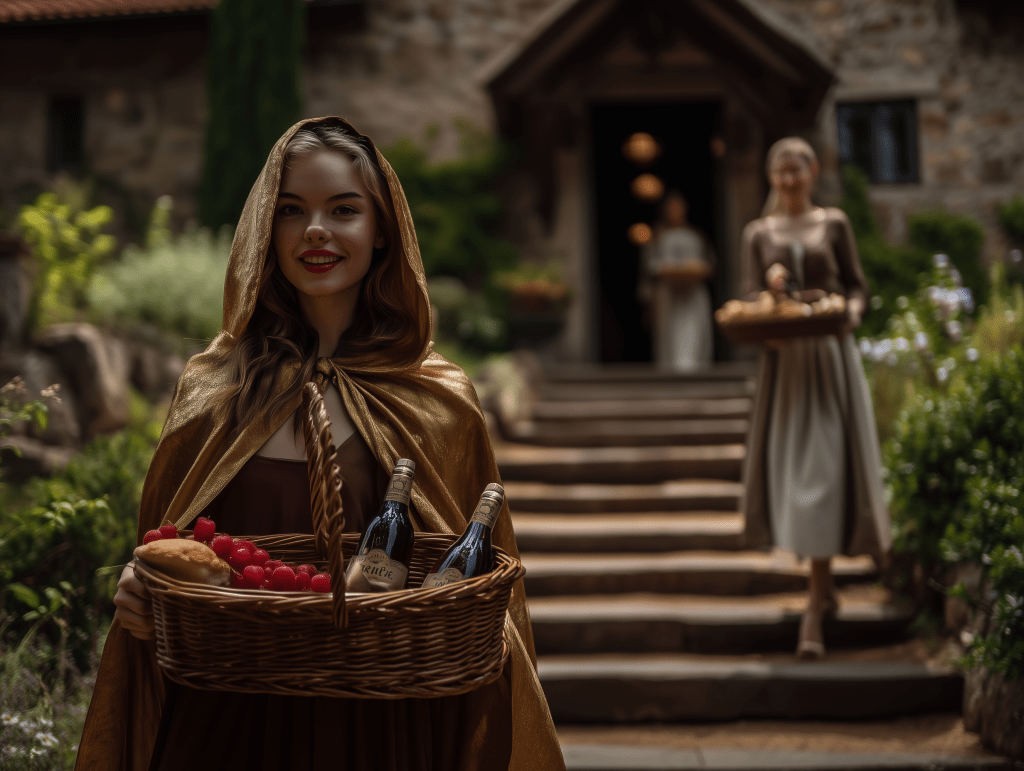
There was once a little peasant girl, pretty and nice as a star in its season. Her real name was Blanchette, but she was more often called Little Golden-hood, on account of a wonderful little cloak with a hood, gold- and fire-coloured, which she always had on. This little hood was given her by her Grandmother, who was so old that she did not know her age; it ought to bring her good luck, for it was made of a ray of sunshine, she said. And as the good old woman was considered something of a witch, everyone thought the little hood rather bewitched too.
And so it was, as you will see.
One day the mother said to the child: ‘Let us see, my little Golden-hood, if you know now how to find your way by yourself. You shall take this good piece of cake to your Grandmother for a Sunday treat to-morrow. You will ask her how she is, and come back at once, without stopping to chatter on the way with people you don’t know. Do you quite understand?’
‘I quite understand,’ replied Blanchette gaily. And off she went with the cake, quite proud of her errand.
Come now and let us reason together, says the Lord. Though your sins be as scarlet, they shall be as white as snow; though they be red like crimson, they shall be as wool. If you are willing and obedient, you shall eat the good of the land, but if you refuse and rebel, you shall be devoured with the sword; for the mouth of the Lord has spoken it.
Recall that in the first story, Little Red Riding Hood was identified by her cloak. But here, the girl has a name: Blanchette, which means little white one. Her identity is not defined by a covering, but rather by her own inherent purity and innocence.
Blessed are they whose transgressions are forgiven and who have no sins to be covered.
In this story the Grandmother is healthy rather than sick. I wonder if this state of these grandmothers symbolizes the “traditions of the fathers” versus true faith based on covenant and firsthand patriarchal testimony.
Archetypes of the grandmother are some of the most sacred ones in all cultures. They represent the crone aspect of womanhood and had dual roles being connected to aging, dying nature and to the powers of the underworld. Grandmother figures are caring, wise, loving and powerful matriarchs. Their value is measured by their cleverness and wisdom rather than external beauty.
II
But the Grandmother lived in another village, and there was a big wood to cross before getting there. At a turn of the road under the trees, suddenly ‘Who goes there?’
‘Friend Wolf.’
He had seen the child start alone, and the villain was waiting to devour her; when at the same moment he perceived some wood-cutters who might observe him, and he changed his mind. Instead of falling upon Blanchette he came frisking up to her like a good dog.
‘’Tis you! my nice Little Golden-hood,’ said he. So the little girl stops to talk with the Wolf, who, for all that, she did not know in the least.
‘You know me, then!’ said she; ‘what is your name?’
‘My name is friend Wolf. And where are you going thus, my pretty one, with your little basket on your arm?’
‘I am going to my Grandmother, to take her a good piece of cake for her Sunday treat to-morrow.’
‘And where does she live, your Grandmother?’
‘She lives at the other side of the wood, in the first house in the village, near the windmill, you know.’
‘Ah! yes! I know now,’ said the Wolf. ‘Well, that’s just where I’m going; I shall get there before you, no doubt, with your little bits of legs, and I’ll tell her you’re coming to see her; then she’ll wait for you.’
Thereupon the Wolf cuts across the wood, and in five minutes arrives at the Grandmother’s house.
He knocks at the door: toc, toc.
No answer.
He knocks louder.
Nobody.
Then he stands up on end, puts his two fore-paws on the latch and the door opens.
Not a soul in the house.
The old woman had risen early to sell herbs in the town, and she had gone off in such haste that she had left her bed unmade, with her great night-cap on the pillow.
‘Good!’ said the Wolf to himself, ‘I know what I’ll do.’
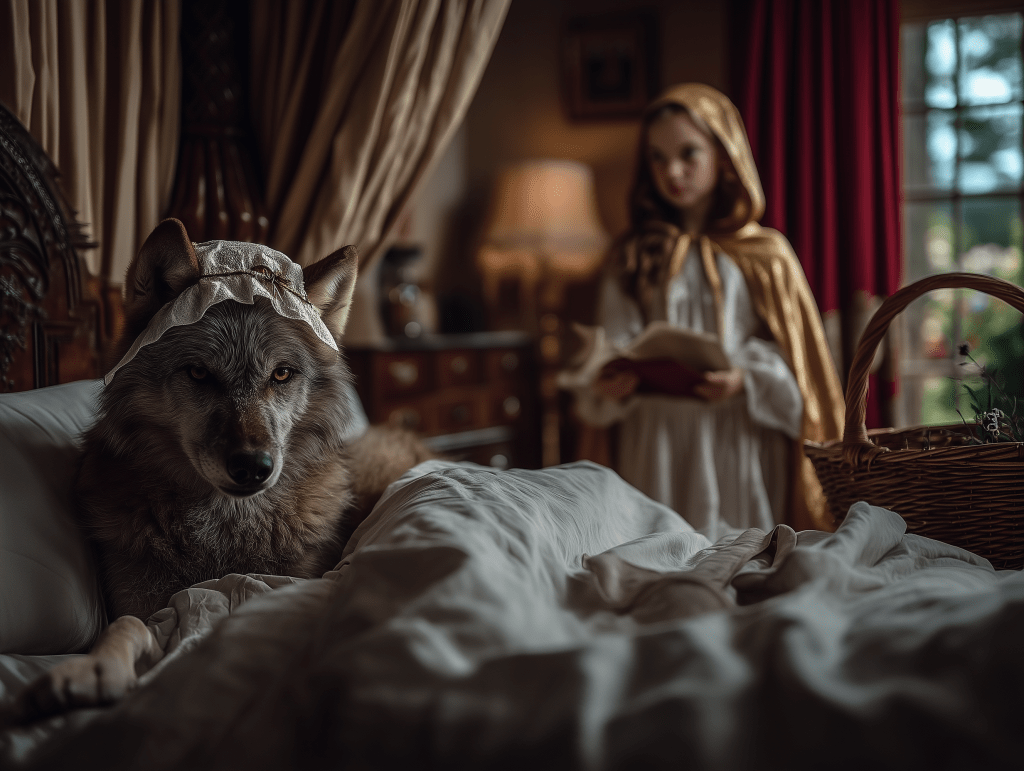
He shuts the door, pulls on the Grandmother’s night-cap down to his eyes, then he lies down all his length in the bed and draws the curtains.
Likewise, you younger, submit yourselves unto the elder. Yea, all of you be subject one to another and be clothed with humility, for God resists the proud and gives grace to the humble. Humble yourselves therefore under the mighty hand of God, that he may exalt you in due time, casting all your care upon him, for he cares for you. Be sober, be vigilant, because your adversary, the Devil, as a roaring lion, walks about seeking whom he may devour — whom resist, steadfast in the faith, knowing that the same afflictions are accomplished in your brethren that are in the world.
Rather than faggot gatherers deterring the wolf by being witnesses, this story has woodcutters nearby. They are strong laborers equipped with axes and have the ability to confront danger. The difference suggests that the world surrounding Blanchette possesses stronger guardianship than the world surrounding Little Red Riding Hood.
III
In the meantime the good Blanchette went quietly on her way, as little girls do, amusing herself here and there by picking Easter daisies, watching the little birds making their nests, and running after the butterflies which fluttered in the sunshine.
At last she arrives at the door.
Knock, knock.
‘Who is there?’ says the Wolf, softening his rough voice as best he can.
‘It’s me, Granny, your little Golden-hood. I’m bringing you a big piece of cake for your Sunday treat to-morrow.’
‘Press your finger on the latch, then push and the door opens.’
‘Why, you’ve got a cold, Granny,’ said she, coming in.
‘Ahem! a little, a little…’ replies the Wolf, pretending to cough. ‘Shut the door well, my little lamb. Put your basket on the table, and then take off your frock and come and lie down by me: you shall rest a little.’
The good child undresses, but observe this! She kept her little hood upon her head. When she saw what a figure her Granny cut in bed, the poor little thing was much surprised.
‘Oh!’ cries she, ‘how like you are to friend Wolf, Grandmother!’
‘That’s on account of my night-cap, child,’ replies the Wolf.
‘Oh! what hairy arms you’ve got, Grandmother!’
‘All the better to hug you, my child.’
‘Oh! what a big tongue you’ve got, Grandmother!’
‘All the better for answering, child.’
‘Oh! what a mouthful of great white teeth you have, Grandmother!’
‘That’s for crunching little children with!’ And the Wolf opened his jaws wide to swallow Blanchette.
But she put down her head crying:
‘Mamma! Mamma!’ and the Wolf only caught her little hood.
Thereupon, oh dear! oh dear! he draws back, crying and shaking his jaw as if he had swallowed red-hot coals.
It was the little fire-coloured hood that had burnt his tongue right down his throat.
A similar interview takes place in this story. However, Blanchette immediately calls out the discrepancies and connects them to the wolf.
Fortunately she does not take off her golden hood, the symbol of her redemption through Christ’s atonement.
O Lord, cover me in the robe of Your righteousness, help me to escape from my enemies, clear the path in front of me! Don’t let any obstacle hinder me, but clear the way in front of me so I can go on safely, and hinder my enemy.
When the wolf attempts to bite down on her, Blanchette calls out for her mother. A parallel could be drawn here: calling out for her mother in this moment as our own instinctual prayers in dire moments. In the first story, the girl did not cry out for a parent when set upon by the wolf.
Yea, cry unto him against the power of your enemies. Yea, cry unto him against the Devil, who is an enemy to all righteousness.
Taking the golden cloak into his mouth was described as having the same effect as a red-hot coal. There is an interesting reference in Isaiah that uses both the mouth and hot coal:
Then flew one of the seraphim unto me, having a live coal in his hand, which he had taken with the tongs from off the altar. And he laid it upon my mouth and said, Behold, this has touched your lips, and your iniquity is taken away, and your sin purged.
IV
The little hood, you see, was one of those magic caps that they used to have in former times, in the stories, for making oneself invisible or invulnerable.
So there was the Wolf with his throat burnt, jumping off the bed and trying to find the door, howling and howling as if all the dogs in the country were at his heels.
Just at this moment the Grandmother arrives, returning from the town with her long sack empty on her shoulder.
‘Ah, brigand!’ she cries, ‘wait a bit!’ Quickly she opens her sack wide across the door, and the maddened Wolf springs in head downwards.
It is he now that is caught, swallowed like a letter in the post.
For the brave old dame shuts her sack, so; and she runs and empties it in the well, where the vagabond, still howling, tumbles in and is drowned.
‘Ah, scoundrel! you thought you would crunch my little grandchild! Well, to-morrow we will make her a muff of your skin, and you yourself shall be crunched, for we will give your carcass to the dogs.’
If you do not accuse each other, God will not accuse you. If you have no accuser you will enter heaven, and if you will follow the revelations and instructions which God gives you through me, I will take you into heaven as my back load. If you will not accuse me, I will not accuse you. If you will throw a cloak of charity over my sins, I will over yours — for charity covereth a multitude of sins.
Joseph Smith, DHC 4:445
Grandmother swallows the wolf in her sack and tells him her plans: your skin will be made into a muff and your carcass will be eaten by dogs. Muffs are a women’s winter accessory to keep hands warm. Seasonal utility paired with humiliation. Grandmother will not eat the wolf as he would have eaten her granddaughter. She is not a predator and his flesh is not suitable except to feed dogs.
..except ye will repent, behold, he shall scatter you forth that ye shall become meat for dogs and wild beasts.
V
Thereupon the Grandmother hastened to dress poor Blanchette, who was still trembling with fear in the bed.
‘Well,’ she said to her, ‘without my little hood where would you be now, darling?’ And, to restore heart and legs to the child, she made her eat a good piece of her cake, and drink a good draught of wine, after which she took her by the hand and led her back to the house.
And then, who was it who scolded her when she knew all that had happened?
It was the mother.
But Blanchette promised over and over again that she would never more stop to listen to a Wolf, so that at last the mother forgave her.
And Blanchette, the Little Golden-hood, kept her word. And in fine weather she may still be seen in the fields with her pretty little hood, the colour of the sun.
But to see her you must rise early.
I first thought of sacrament reading this last section of the story, however these victuals are more than just bread, she is given cake.
And they brought in the ark of the Lord and set it in his place, in the heart of the tabernacle that David had pitched for it. And David offered burnt offerings and peace offerings before the Lord. And as soon as David had made an end of offering burnt offerings and peace offerings, he blessed the people in the name of the Lord of Hosts. And he dealt among all the people, even among the whole multitude of Israel, as well to the women as men, to everyone a cake of bread, and a good piece of flesh, and a flagon of wine. So all the people departed, everyone to his house.
After rescue, returning peace to the child and then the child to her mother is on the same level as the celebration when David brought the ark of the Lord into the heart of the tabernacle.
Similarly at the end of a Nazarite vow the priest serves the devotee cake and wine.
And the priest shall take the boiled shoulder of the ram, and one unleavened cake out of the basket, and one unleavened wafer, and shall put them upon the hands of the Nazarite, after the hair of his separation is shaven. … This is holy for the priest, with the wave breast and heave shoulder, and after that the Nazarite may drink wine.