Introduction
Many people think that faith and reason are opposites; that belief in God and tough-minded logical reasoning are entirely incompatible. They are wrong.
Belief in God is far more rational than atheism.
Logic can show that there is a God. If you look at the universe with common sense and an open mind, you’ll find that it’s full of God’s fingerprints.
We’ll go over a few of the main evidences from the “Core Sciences” that there is a God:
Physics
Chemistry
Biology
And before we get too far, let’s not forget the language of science: Math. Its universality is why Einstein said:
“The most incomprehensible thing about the universe is that it is comprehensible”— through mathematics.
Physics: The Law of Cause & Effect
All scientists today agree that the universe is not infinitely old, that it had a beginning in the Big Bang.
If the universe had a beginning, then it didn’t have to exist. And things which don’t have to exist, must have a cause.
There’s confirmation of this argument from Big Bang Cosmology. We now know that all matter, that is, the whole universe, came into existence some 13.7 billion years ago and it’s been expanding and cooling ever since. No scientist doubts that anymore, even though before it was scientifically proved, atheists called it “creationism in disguise.”
Newton’s First Law of Motion (1687), also called the Law of Inertia states that an object at rest will stay at rest and an object in motion will remain in motion unless acted upon by an external force (like friction, gravity, or a push).
Thomas Aquinas, the great 13th century philosopher and theologian made the not very startling observation that things move.
But nothing moves for no reason. Something must cause that movement. And whatever caused that, must be caused by something else, and so on. But this causal chain cannot go backwards forever. It must have a beginning. There must be an Unmoved Mover to begin all the motion in the universe: a first domino to start the whole chain moving, since mere matter never moves itself.
Another way to explain this argument is that everything that begins must have a cause. Nothing can come from nothing. So if there is no first cause, there can’t be second causes. Or anything at all. In other words, if there’s no creator, there can’t be a universe.
And all things demonstrate there’s a God: This earth and everything on it, and its motion, and all the planets moving in their appointed places — these all prove there’s a Supreme Creator.

Chemistry: Elemental Building Blocks
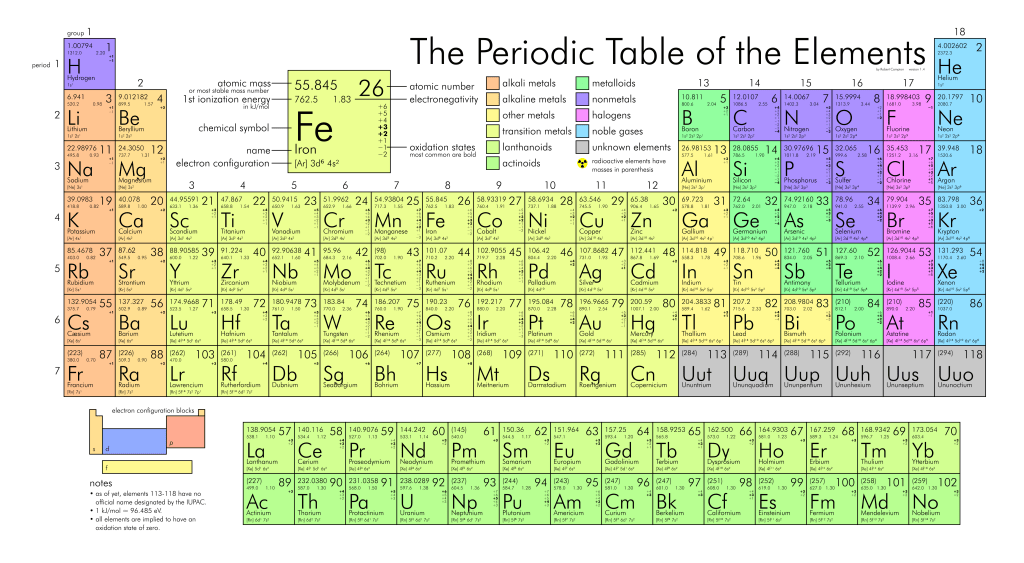
Astrophysicists tell us that this first big bang yielded only a handful of fundamental elements, and that it would take billions and billions of years for the nuclear furnaces of trillions of stars to yield the 118 elements in the periodic table.
If we were to zoom in and consider just our solar system there are additional proofs that a designer intervened.
Every element on the periodic table requires increasing amounts of heat and pressure within a star in order to form. The sun in our solar system only has the ability to create elements 1 through 6, or Hydrogen through Carbon.
They Might Be Giants wrote a song explaining this concept:
The sun is a mass of incandescent gas
A gigantic nuclear furnace
Where hydrogen is built into helium
At a temperature of millions of degrees
The process by which the nuclei of atoms combine, changing the number of protons and forming a new element, is called nuclear fusion.
Medieval alchemists fundamentally recognized the possibility of creating one element from another – in the race to turn lead into gold, for example – but misunderstood the physics behind what was required; which in this case is the extreme heat, pressure and energy found only in nuclear reactions. Our sun just doesn’t have the mass and firepower to have created the majority of elements that are found in natural abundance on this planet. Elements beyond basic Carbon (Atomic #6) HAD to have come from some other source.
Abundance of elements that our sun could have produced:
#1 – Hydrogen (H) – 0.14%
#2 – Helium (He) – 0.0000008%
#3 – Lithium (Li) – 0.002%
#4 – Beryllium (Be) – 0.00028%
#5 – Boron (B) – 0.001%
#6 – Carbon (C) – 0.02%
The two most abundant elements that could have formed in our sun are Carbon (C) and Hydrogen (H).
Carbon is a fundamental building block of life, forming the basis of DNA, proteins, sugars, and fats in living organisms.
While Hydrogen (H) is the most abundant element in the universe, it’s rarely found as a pure gas on earth. It is mostly found combined with other elements like Oxygen (i.e. H2O)
Some of the most abundant elements on our planet; the building blocks for life and the resulting compounds needed to sustain life, were brought here from somewhere else.
In order by natural abundance:
Oxygen (O) – 46.1% — Atomic #8
Silicon (Si) – 28.2% — Atomic #14
Aluminum (Al) – 8.2% — Atomic #13
Iron (Fe) – 5.6% — Atomic #26
Calcium (Ca) – 4.15% — Atomic #20
Sodium (Na) – 2.36% — Atomic #11
Potassium (K) – 2.09% — Atomic #19
Magnesium (Mg) – 2.33% — Atomic #12
…See–yonder is matter unorganized. Go ye down and organize it into a world like unto the worlds that we have heretofore formed.
Biology: Law of Biogenesis
In this material, natural world, life comes from previously existing life of its own kind.
Can non-living chemicals gave rise to Life? That is biologically impossible. It is singularity without a cause.
How do you get life from non-life?
Well, you’re going to need another something-from-nothing leap of faith, some kind of biological, second “big bang”. For all the mind-blowing advancements we’ve made in physics, biology, and chemistry in just the past 100 years, we’re still no closer to making it happen. We don’t have a clue. The closer we look, the wider the chasm.
I mean, sure, we’ve learned a lot about how to manipulate life forms, how to add and subtract DNA material, even map the human genome, but we have no idea how to literally create life from dead stuff.
Now look, at this point we still only have physics, chemistry, and some basic biology — or matter, energy, and simple life, if you will.
According to the atheists, it was abiogenesis; which is the hypothesis that life started from non-life through natural chemical processes eventually leading to the first cells.
They refer to the primordial soup containing nucleic acids (RNA & DNA), proteins, and lipids and rain which fell over millions of years and eventually gave rise to the formation of simple single celled organisms.

Math: Statistics
DNA are the blueprints of life. The complex instructions that store, transmit and execute the information needed to build and sustain every living organism.
The human genome has 3.2 billion letters (bases) per copy. The equivalent printed copy would be a set of 4267 books all of which are 300 pages long.
“But life started with a single cell organism!”
No worries. We’ve just reduced the equivalent DNA complexity down to one 300 page book. So, to put this into perspective, random accident produced a perfect copy of Wuthering Heights. Over a long enough period of time anything is possible. But is it probable?
The expected number of years to get a perfect copy with a random letter generator going at about 1 billion characters per second is about 10 to the millionth power (that’s 1 with one million zeros). The gap in years between the known age of the universe and the time to accidentally write a perfect DNA sequence for a single celled organism is 10 to the 999,939 power.
Not at all probable and mathematically IMPOSSIBLE given the constraints on the age of the universe.
The existence of the book Wuthering Heights demands that there is an author. The design, complexity and variety of life DEMANDS that there is a Designer.
How did abiogenesis occur? …This notion that something can come from nothing. Where’s the evidence? Even atheists concede there isn’t any; only theories and proposals all of which require more time than the known age of the universe and statistically impossible odds.
Additionally, we still don’t have a way to account for the great diversity of life forms, I mean, the huge differences between bacteria, plants and animals. Nor do we have a way to account for the differences between man and animal. We still don’t have an anthropology at this point.
So, we’re going to need a kind of anthropological third big bang to account for all this, which of course is what Darwin was after in his “Descent of Man” thesis. Now look, Darwin answered a lot of questions, but he could never answer the core question: How did evolution begin?
If you reach the conclusion that everything that’s going on here could possibly be by random chance, then read Darwin’s Black Box. There’s a little over 200 different things that have to line up perfectly in order for your blood to clot. If any one of those 200 things don’t happen simultaneously—it’s a little over 200—if any one of those don’t happen simultaneously, you will die.
Atheism requires faith. It takes faith to believe in everything coming from nothing. It takes only reason to believe in everything coming from God.
Human Reasoning & Free Will
We’re still not done describing the world that is all around us. A final “big bang” is going to be required to explain how a mechanistic animal brain can become a self-reflective human mind. Even the lowest life forms have brains and central nervous systems. I mean, how does something like that become the mind of a Michelangelo, a Shakespeare, a Beethoven? Come on, animals don’t do art, and they don’t appreciate beauty.
But the problem is even more basic than that. How do you account for free will and introspection, let alone man’s pressing existential drive to ask, “why?” Well we’re going to need some kind of psychological 4th big bang to account for man’s moral and aesthetic sense — his search for meaning, significance, and purpose, and of course his appreciation for the true, the good, and the beautiful. And again, you must understand, these problems require bangs — I mean, sudden binary pops into existence, since there’s no evidence for any gradual development in any of these.
Scientific proof uses observation, weight, and measure to test and verify claims about reality.
Beyond the scientific method, there is truth that cannot be measured.
- Philosophical truths (logic) come from pure reason rather than observation. No experiment is needed – logic itself compels the conclusion.
- Moral truths (e.g. murder is evil). You can’t measure morality with a ruler or a scale, but moral truths are binding across culture and time.
- Historical truths tell us what actually happened in the past. You can’t rerun history in a lab; we rely on evidence, testimony and records.
- Aesthetic truths (e.g. sunsets are beautiful). While subjective taste can vary, there is a common human recognition of beauty and order that transcends measurement.
Moral Law demands a Moral Lawgiver
Moral laws are fundamentally different from physical laws such as Physics, Chemistry and Biology.
All good people are appalled by the sufferings of the innocent. When an innocent person is struck by a painful disease, or tortured or murdered, we naturally feel sadness, helplessness, and often rage.
Many people have claimed that such suffering is a proof that God does not exist. Their argument goes like this:
God is all good and all powerful.
Such a God would not permit unnecessary suffering. Yet, we constantly observe unjust suffering. Therefore, at least one of the premises about God must be false.
Either God is not all good
or He is not powerful.
Or He just doesn’t exist.
What’s wrong with this argument?
First, let’s examine what we mean when we say that God would not permit unjust suffering.
There are two categories of suffering: Suffering caused by human beings, which we call moral evils, and suffering caused by nature, for instance earthquakes or cancer.
Free will explains how God could be good and allow moral evil. Because God has given people free will, they are free to behave against God’s will. The fact that they do evil does not prove that God is not good.
In addition, if there were no God, there would be no absolute standard of good. Every judgment presupposes a standard. And that’s true of our moral judgments, too. What is our standard for judging evil to be evil? The most we could say about evil — if there were no God — was that we, in our subjective taste, didn’t like it when people did certain things to other people. We wouldn’t have a basis for saying an act was ‘bad’, only that we didn’t like it. So the problem of human evil exists only if God exists.
As for natural suffering, that poses what appears to be a more difficult question.
We see an innocent child suffer, say from an incurable disease. We complain. Understandable. We don’t like it. Understandable. We feel it is wrong, unfair, and shouldn’t happen. Understandable, but illogical, unless you believe in God!
For, if you do not believe in God, your subjective feelings are the only basis upon which you can object to natural suffering. OK, you don’t like it. But how is your not liking something evidence for God not existing? Think about it. It’s just the opposite. Our judgments of good and evil, natural as well as human, presuppose God as the standard. If there’s no God, there’s neither good nor evil. There’s just nature doing what it does.
If nature is all there is, there is absolutely no need to explain why one person suffers and another doesn’t. Unjust suffering is a problem only because we have a sense of what is just and unjust. But where does this sense come from? Certainly, not from Nature. There’s nothing just about nature. Nature is only about survival.
What, in other words, does it mean for suffering to be ‘unnecessary or wrong?’ How is that determined? Against what standard? Your private standard means nothing. My private standard means nothing. We can talk meaningfully about suffering being ‘unnecessary’ or wrong only if we have an underlying belief that a standard of right and wrong objectively exists. And if that standard really exists, that means there is a God.
Moreover, the believer in God has an incomparably easier time than the atheist psychologically as well as logically in dealing with the problem of natural suffering.
If you accept that a good God exists, it is possible to also believe that this God somehow sets things right, if not in this world, then in the next.
For the atheist, on the other hand, no suffering is ever set right. There is no ultimate justice. The bad win and the good suffer. Earthquakes and cancer kill. End of story. Literally.
If nature is all there is, how can a sensitive person remain sane in a world in which tsunamis wipe out whole towns, evil men torture and murder innocent victims, and disease attacks people indiscriminately?

Anecdotal Evidence
There are first hand witnesses to the existence of God, if one accepts the written record.
Yet skeptics can dismiss these testimonies, attributing them to bias, delusion, or ulterior motives.
When a person interacts with God it is necessarily anecdotal. This allows others to have their own journey of faith when they’re ready. Heaven honors agency.
Prior to hearing the first hand witness of Denver Snuffer, one of the most impactful testimonies for me was shared more than ten years ago during an LDS fast and testimony meeting. A man who had recently converted told the story of how he kept asking God, “Show me! Show me!” and didn’t feel like he was getting any answers. One day, he decided to change his prayer to, “Help me recognize what you’ve been showing me all along.” He met the missionaries the next day.
We have all interacted with God (Yes, even atheists), but the extent to which we actually discern and recognize Him is entirely dependent on us.
When I was a sister missionary in the Canary Islands my companion and I contacted a man sitting in his apartment window. He very confidently declared to us, “I don’t believe in God.”
Now, I don’t normally have quick comebacks. That’s not my personality at all. But in this moment with this man, my mouth was immediately filled with,
“That’s OK. God believes in you!”
And with it came a power punch from the Spirit. I felt it. I saw the impact on him. He was visibly shocked — not only at the words, but at the power they carried. Two young teenage boys, who I assume were nephews, burst out laughing at the obvious “gotcha”. I knew that God helped me deliver more than just a clever comeback. Truth had been delivered straight to his heart.
My own interactions with God are specific answers through improbable coincidences, silent impressions with directions to serve, inaudible conversations in prayer. None of which are provable outside of myself. What it does demonstrate is that a personal witness is possible, if you’re interested.

The Benefits of Belief
If God exists, then the world didn’t just evolve by chance, but by deliberate design. There’s an Artist behind this incredible work of art—this big and beautiful world.
If God exists, we’re living in a great story, an epic like “The Lord of the Rings,” with real heroes and heroic tasks. Ultimately, all the twists and turns of this epic narrative will be paid off, everything will make sense. It will even have a happy ending, not necessarily, or even likely, in our own lifetime—even Moses didn’t get into the Promised Land—but over the grand course of time in an afterlife, which exists as surely as God exists.
If God exists, the presence of evil, hard as it is to accept, makes sense. God allows it for a reason—namely, to preserve our free will. And God will reconcile all injustices in the end. If there is no God, life is one big crapshoot.
If God does exist, morality is a real, objective feature of the world. If there is no God, morality is just the rules we make up for this little game of life we play.
If God exists, love is the nature of an eternal reality. If there is no God, love is just a fleeting feeling, no more than a bunch of chemical and neurological interactions.
If God exists, you are of infinite value. He knows you as a parent knows his child. He’s accessible to you. If there is no God, each of us is as insignificant as a rock on an unknown planet.
If God exists, death is conquered because if there is a God there is a reality outside of space and time. If there is no God, there is nothing immortal, and all the good things in life are destroyed forever. You, and everyone you love, and everything you think matters are all consigned to oblivion. If there is no God, life is pointless. Everything we’ve done and lived for will ultimately be in vain.
Can I prove with an absolute certainty that God exists? I can make the case that overwhelming evidence suggests that He does. But no I can’t prove that He exists with absolute certainty. That’s likely part of His plan. God deliberately doesn’t give us absolute proof so that we’re free to choose or not to choose to believe in Him.
So which way do you want to go?
Be honest. Doesn’t your heart at least hope that there is a good God, a transcendent Validator of love and all the highest human values? Of course it does. Why would anyone not wish that life has some ultimate purpose; that good and evil are real; that there is ultimate justice; that our love for others means something?
If you choose to live as if there is a God—even if you are not sure there is a God—you lose nothing and you gain everything.
Religious Christians and Jews are happier, live longer, and are more charitable than their less observant or secular fellow citizens. These are not my opinions. These are the findings of a multitude of scientific studies.
If you have been an atheist for a while, it may be difficult for you to change your thinking, even if you find some merit in the many rational arguments for God’s existence. But you can change your behavior. You can live as if God’s exists, even if you hold doubts. Why not? As I said, you lose nothing and you have everything to gain.
This behavioral approach is far from new. The Jews have long had a saying, “We will do, and we will understand,” which acknowledges that action often precedes understanding. So why not begin with an action? Why not pray the prayer of the skeptic?
“God, if you exist, you must know that I’m not a believer.
So, please, God, give me the gift of faith, in your time and in your way. I want to believe whatever is true. Amen.”
If you say that and mean it, and give it some time, be prepared, because He will not ignore that prayer.
Go on, say it. Find a private place and say it. Your Creator is listening.

____________
Excerpts from Prager U, Peter Kreeft & Frank Pastore:
The Benefits of Belief