Distance
Earth is located in the “habitable zone” or “Goldilocks zone” of the solar system, the region around a star where the temperature is just right for liquid water to exist on a planet’s surface. This zone is neither too hot nor too cold, making it ideal for life as we know it.
At about 93 million miles (150 million kilometers) away from the Sun, Earth receives the perfect amount of solar energy. If Earth were closer, the oceans would evaporate, the atmosphere would be destroyed, and life would be scorched by the Sun’s harsh rays. If Earth were farther, water would freeze, resulting in a perpetually icy climate where spring would never bring new plants and the animals would eventually die of starvation. This ideal distance ensures that Earth’s surface temperatures are suitable for maintaining liquid water, essential for all known forms of life.
Earth’s position in this zone contributes to the maintenance of an atmosphere that traps heat through the greenhouse effect, keeping the planet warm enough to support life. Earth’s temperature, which is a function of the distance from the sun, allows for a stable water cycle, where water can evaporate, form clouds, and precipitate back to the surface. This cycle is crucial for distributing heat and supporting plant and animal life.
Compared to other planets, Earth’s position in the habitable zone is unique in our solar system, as closer planets like Venus are too hot, and farther planets like Mars are too cold. This unique position allows Earth to support a diverse array of life forms.
Atmosphere
The atmosphere that surrounds the Earth acts as a shield against the Sun’s harmful ultraviolet (UV) radiation. It exists as a gaseous layer from the surface of the planet extending upwards of about 800 miles, or 4 million feet. For reference, most airplanes fly at an altitude between 33,000 and 42,000 feet. The ozone layer, located in the stratosphere, absorbs and scatters the majority of the sun’s UV rays, protecting living organisms from cellular damage that could lead to cancers and other health issues. Our atmosphere also helps regulate the planet’s temperature through the greenhouse effect. Heat from the Sun is trapped during the day, preventing it from escaping back into space at night. The atmosphere absorbs and redistributes heat, ensuring more stable temperatures. This process maintains a relatively stable and warm climate, essential for the survival of most life forms and moderates the temperature against extremes between day and night. Without an atmosphere, the Earth’s surface would experience drastic temperature fluctuations.
The mix of gasses within the atmosphere provides the oxygen necessary for aerobic respiration. Although made up of mostly inert nitrogen (78.1%), the air also contains carbon dioxide (0.04%), which is essential for photosynthesis in plants. During photosynthesis, plants convert carbon dioxide and sunlight into glucose
and oxygen, providing the foundation for most food chains and contributing to the oxygen supply (20.9%).
The atmosphere facilitates the evaporation of water from surfaces, the formation of clouds, and precipitation. This cycle is vital for replenishing water sources and supporting plant and animal life.
When meteoroids or other space debris enter the atmosphere, they burn up due to friction through this gaseous layer, reducing the likelihood of impacts that could cause significant damage to the planet’s surface. Most space rocks burn up in the atmosphere and create the phenomenon we call “shooting stars.”
Jupiter, Saturn, Uranus and Neptune all have similar atmospheres to one another which are made of made of mostly hydrogen and helium with trace amounts of methane and ammonia, both of which are toxic and potentially fatal. Higher amounts of methane on Uranus and Neptune create their signature blue colors.
There is no substantial atmosphere on Mercury causing extreme temperature fluctuation between day (750°F) and night. (-300°F). The atmospheres on Venus and Mars are primarily composted of carbon dioxide (95%), nitrogen (2.8%) and argon (2%). However, the atmosphere of Venus is so thick that heat from the sun does not escape at all. Day or night, the temperature on Venus averages about 900°F. Mars’ atmosphere is about 100 times thinner than Earth’s, or 40,000 feet which contributes to extreme temperature fluctuations with an average temperature of about -63°F.
The composition of Earth’s atmosphere is entirely unique in the solar system and a perfectly blend of gasses that facilitate plant and animal life.
Mass
The amount of mass or matter in an object determines the gravitational pull of that object. The mass of a planet determines the amount a gravity a planet has.
Reduced gravity would first result in a thinner atmosphere and lower concentrations of oxygen. A planet with less mass would not have the gravitational pull required to create rainfall from saturated clouds. Evaporation rates would change and without sufficient atmospheric pressure, liquid water might not be able to exist on the planet’s surface leading to the loss of oceans, lakes and rivers. Our thick atmosphere that acts as a shield would deplete into space which would affect life-supporting processes like photosynthesis.
If the planet had more mass and therefore more gravity, harmful gasses such as methane and ammonia would stay low to the ground instead of rising up and out of the breathable air dissipating into space. Greater mass would also contribute to an increase in tectonic activity leading to more frequent earthquakes and volcanic eruptions. Movement would be more energy intensive potentially limiting the range and speed of humans and animals.
Rotation
The earth’s rotational period is perfectly timed so that when we get tired, it gets dark outside. When we have slept enough, the sun comes up, making it light again.
How quickly or slowly a planet turns also affects the weather. If Earth rotated more quickly the winds would be so strong that there would be tremendous hurricanes everywhere. Survival would be difficult.
On the other hand if the earth related too slowly (giving us longer days and longer nights) the temperature shift would be extremely hard on the environment. The longer the nights the colder they get, and the longer the days, the hotter they get.
Comparing the opposite ends of the solar system spectrum: one solar day on Jupiter is only 10 hours. One solar day on Venus is 5,832 hours or 243 days. Mars is the most similar to Earth with a solar day of 25 hours.
Tilt
Earth has a tilt of about 23.5 degrees. Due to this tilt we have changing seasons with different parts of the planet receiving varying amounts of sunlight throughout the year.
All planets in the solar system have some degree of tilt, ranging from barely there Mercury with a 0.034 degree tilt to Venus’ tilt of 177.4 degrees. Venus effectively rotates upside down, and opposite direction to most planets a phenomenon known as retrograde rotation.
Earth’s tilt causes the different hemispheres to receive varying amounts of sunlight throughout the year, leading to the changing seasons. This balance helps to moderate global temperatures and create a range of climatic zones, from tropical to polar.
Seasonal changes are due to the tilt of the Earth and influence agricultural cycles, allowing for the cultivation of a wide variety of crops. This creates diverse habitats and ecosystems, each with unique flora and fauna adapted to specific climatic conditions. This biodiversity is vital for the stability and resilience of ecosystems. Many species rely on seasonal changes to guide their migration patterns, reproduction cycles, and feeding habits. These patterns help maintain ecological balance and species survival.
The tilt also helps distribute solar energy more evenly across the planet, preventing extreme temperature differences between the equator and the poles. No one region will experiencing perpetual extreme temperatures. For instance, polar regions have long periods of sunlight and darkness but are not subjected to constant freezing or heating. This regulation fosters a stable and habitable climate.
Seasonal variations drive ocean currents and weather systems, which are crucial for distributing heat, nutrients, and moisture around the globe. These systems influence weather patterns, rainfall distribution, and climate stability.
Plants bloom and produce fruits and flowers because there are seasons, made possible by the tilt of the planet.
Magnetosphere
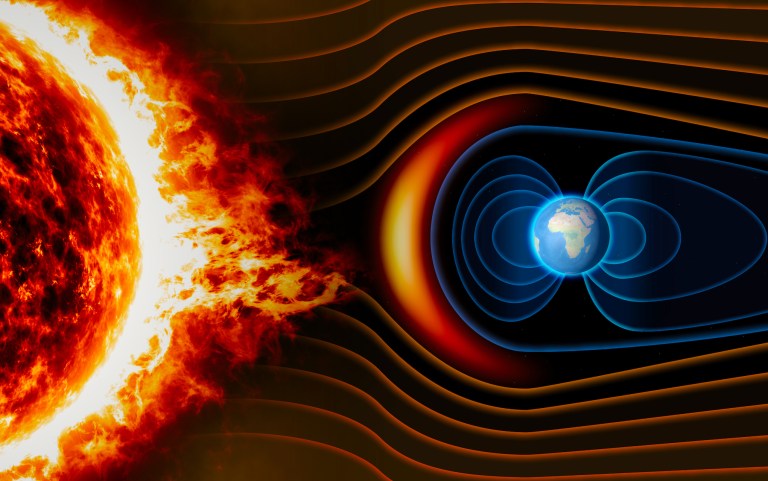
The entire earth has a magnetic field surrounding it called the magnetosphere. The magnetosphere deflects the solar wind, a stream of charged particles (plasma) emitted by the Sun. By deflecting the solar wind, the magnetosphere prevents the Earth’s atmosphere from stripping away which would expose the surface to harmful radiation, cosmic rays, and high-energy particles from outer space. This invisible force field protection maintains the pressure and composition of the atmosphere including the upper ozone layer that absorbs and scatters UV radiation.
The magnetosphere interacts with the solar wind to create geomagnetic storms. While severe storms can disrupt satellite communications and power grids, the presence of the magnetosphere generally moderates these interactions, preventing more frequent or severe disruptions to weather and climate systems.
Many species, including birds and marine animals, use Earth’s magnetic field for navigation during migration. This ability is crucial for their survival and reproductive success.
Although the magnetosphere blocks most of the solar wind coming from the sun, some of the particles that make up the solar wind get trapped in the magnetic field, mostly around the North and South Poles. As these particles travel in the earth’s magnetic field, the start hitting gasses in the earth’s atmosphere. The energy of the collisions between these particles and the atmosphere’s gasses produces beautiful colors in the sky. These displays of color are called auroras and they are easiest to see if you live in the norther or southern parts of the globe.

Conclusion
The distance from the sun and all essential characteristics that allow life to exist are not serendipitous coincidences, but intentionally designed by a Creator. In fact, when considering all of the accidents that have to align to maintain the delicate life balance in just the design of the planet, it becomes a statistical impossibility. God placed the Earth exactly where it need to be.
Yea, even the earth, and all things that are upon the face of it, yea, and its motion, yea, and also all the planets which move in their regular form doth witness that there is a supreme creator.
Alma 16:9 (RE), Alma 30:44
Our atmosphere is uniquely composed and perfectly balanced to sustain life. The mass and gravitational pull allows for both rain to fall and harmful chemicals to dissipate. The rotational period that He ordained for the earth keeps the temperature in balance to protect people, animals, plants and other creatures. The tilt of the planet provides for variety in seasons and is the invisible gardener providing natural planting, watering and harvest for wildlife. He has even placed an invisible shield of protection over this world against the solar winds.
Indeed, despite differences in culture and vocabulary, records kept by every religious tradition recognize this work of intelligent design.
Judaism
For thus says the Lord that created the heavens, God himself that formed the earth and made it (he has established it, he created it not in vain, he formed it to be inhabited)
Isaiah 45:18 KJV
Hinduism
I am the source of all spiritual and material worlds. Everything emanates from Me. The wise, who know this perfectly, engage in My devotional service and worship Me with all their hearts.
Bhagavad Gita, Chapter 10, Verse 8
Islam
It is Allah who made for you the earth a place of settlement and the sky a canopy and formed you and perfected your forms and provided you with good things. That is Allah, your Lord; then blessed is Allah, Lord of the worlds.
Qur’an 40:64
Sikhism
There is but One God, His name is Truth, He is the Creator, Fearless, without enmity, the Timeless Form, Unborn, Self-existent, known by the Grace of the Guru.
Guru Granth Sahib, Japji Sahib, Pauri 1
Science may be able to provide the equations to measure gravity, distance, tilt and radiation. But the Creator Himself provides context and motivation. And He has spoken to more than one people. All truth can be circumscribed into one great whole.