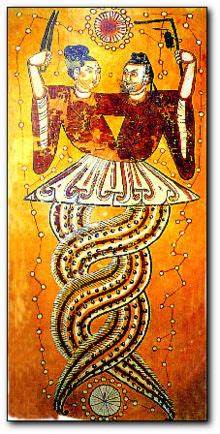
Nüwa’s name, 女媧, is made up of the Chinese character for woman, nǚ (女), and a character that is completely unique to her name, wā (媧). In other styles of romanization, her name is sometimes written as Nü Gua or Nü Kua. Nüwa is also sometimes referred to respectfully as wā huáng (媧皇) which translates literally as “Empress Huang.” Nüwa is married to her brother Fuxi (伏羲). In some versions of this Chinese myth, Fuxi is credited with creating mankind with Nüwa through their union. He’s seen as the inventor of hunting, cooking, and the Chinese writing system. Note: If you are unfamiliar with the meaning embedded in the Chinese written characters, we’d recommend checking out the post Gospel in China’s Pictorial Language
One day, Gonggong (龔工), the god of water, and the god of fire, Zhurong (祝融) (fire, see Isaiah 10:17-18 KJV) became locked in a massive battle that would determine the ruler of heaven. Wildfires raged and floods plagued the countryside. Gonggong, who was motivated by evil, ultimately lost the fight (See Son of Perdition). Gonggong was so angered that he bashed his head against Buzhou mountain—one of the four pillars holding up the heavens. The earth began to tremble and the pillar collapsed and ripped a hole in the sky. The western sky 西天 (xī tiān) suddenly collapsed, causing a huge divide on the Earth, separating life as the ancients know it. The torrential water flooded all the lands; fierce animals 野兽 (yě shòu) preyed on men. It was a time of chaos. Many who fought unfortunately lost their lives.
..the fountains of the great deep broken up, and the windows of heaven were opened…
Genesis 7:11 KJV
Nüwa and her brother, Fuxi, happened to escape into a boat at just the right moment (i.e. Ark, see Genesis 7:7 KJV) . After the floodwaters died down, they discovered that they were the last humans left on Earth.
Although they realized that they should procreate to continue the survival of the human race, they were deeply conflicted about the idea since they were siblings. Fuxi and Nüwa, decided to ask for heaven’s guidance. After praying, they came to the conclusion that they needed to undergo a divination test that could indicate whether they were destined to be husband and wife.
Fuxi and Nüwa ascended two different mountains and lit two fires. They decided that if the smoke blew straight up that they would not get married. But, if the smoke trails intertwined with one another, it was a sign that they should continue the human race. The smoke from their fires twisted and curled in with one another so Fuxi and Nüwa became husband and wife and repopulated the earth.
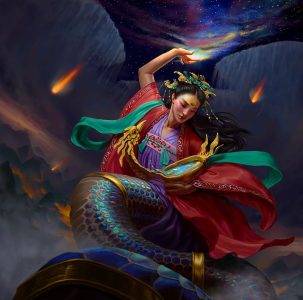
Nuwa observed the destruction from the flood. She vowed to take responsibility for filling the gap in the sky. Consequently, she embarked on a harsh journey that exhausted her mind and her physical capacity. After numerous tries, she still couldn’t find a way to make up the sky. At this point, her physical capacity exhausted the last storage of her energy. Nuwa opted to rest but inevitably fell asleep. During her deep sleep, an epiphany came knocking at her consciousness. In the dream, a fairy [see Angel] told her that the top of Kunlun Mountain was full of five-color gems 五彩石 (wǔ cǎi shí) (Note: Consider the similarity to the multi-colored nature of the rainbow.) Refining the gems with fire, turning them into molten lava Nuwa held up the lava with both hands and took it to fill the sky again and again. She breathed a sigh of relief until the gap in the sky stopped leaking.
The ancient Chinese historian Sima Qian (司馬遷), recorded the following account of Nüwa’s heroic deed:
The pillars of Heaven were broken and the corners of the earth gave way. Hereupon Nü Kua melted stones of the five colours to repair the heavens, and cut off the feet of the tortoise to set upright the four extremities of the earth. Gathering the ashes of reeds she stopped the flooding waters, and thus rescued the land.
In this way, Nuwa mended the sky, the flood was tamed, and the terrifying beast disappeared. Seeing that the situation was gradually improving, the people rebuilt 重建 (chóng jiàn) their homes one after another, and life soon returned to its former peace.
Despite the difference in gender, Note the similarity of Nuwa to the name Noah who dealt with the flood in the Biblical account. Nuwa and Fuxi, were similar to the first man and woman in that all living human beings after the flood could trace their parentage directly through them.
Sources:
Nuwa – Mythopedia
Nuwa – New World Encyclopedia
Nuwa: Goddess of Creation and the Female Emperor of Mankind (timelessmyths.com)

I believe God has the ability to speak to people through the symbols that are most meaningful within one’s culture. The rainbow is normally a bow of light that extends across the landscape. On 29 August 2022 a rare rainbow cloud appeared over China. The shape and colors might cite people’s minds back to their ancient story of Nuwa patching the sky with the molten multi-colored rocks. To what end? Perhaps to awaken the people to the truths in what have been dismissed as mere myth?