In the Egyptian afterlife, judgment unfolded through the solemn rite known as the Weighing of the Heart, a rite in which the moral truth of a person’s life is revealed.
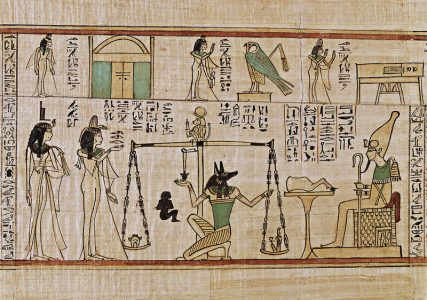
After death, the deceased is led into the Hall of Two Truths, where their heart—the seat of intention, memory, and conscience—is placed on a great scale opposite the feather of Ma’at, the divine symbol of truth, justice, and cosmic order.
Anubis, the guardian of the dead, adjusted the scales, while Thoth, the scribe of the gods, recorded every detail.
As the heart is weighed, the gods stand witness to the integrity of the soul’s earthly choices. If the heart proves as light and balanced as the feather, the individual is judged righteous and allowed to pass into the eternal, blissful Fields of Reeds, becoming an akh—a transfigured, luminous spirit.
But if the heart is heavy with deceit, injustice, violence, or selfishness, it tipped the scales toward condemnation, and the soul was handed over to Ammit, the Devourer, to be consumed and erased from existence.
Thus the outcome of judgment was stark and final: harmony with Ma’at meant everlasting life, while a heart weighted by wrongdoing meant the second death, annihilation.
O my heart which I had from my mother, O my heart which I had upon earth, do not rise up against me as a witness in the presence of the Lord of Things; do not speak against me concerning what I have done, do not bring up against me anything I have done in the presence of the Great God, Lord of the West (Osiris).
Spell 30
This is the centerpiece of Egyptian judgment and one of the most iconic scenes in world religion.
Procedure:
-
The heart (ib) — the center of conscience, memory, intention — is placed on a scale.
-
The feather of Ma’at (truth and justice) is placed on the other side.
-
Thoth records the measurement.
-
Anubis checks for balance.
-
Ammit the Devourer waits for souls who fail.
Outcome:
-
If the heart is lighter than or equal to the feather → eternal life
-
If the heart is heavier → the soul is destroyed (second death)
Book of the Dead Chapter 125B Negative Confession:
O broad of step who comes from Iunu I have done no evil
O flame embracer who comes from Kheraha I have not robbed
O beaked god who comes from Khemenu I have not been greedy
O swallower of shades who comes from the cavern I have not stolen
O flaming faced who comes from Rosetjau I have not killed anyone
O Double Lion who comes from the sky I have not taken from offering lists
O fiery eyed who comes from Khem I have not committed corruption
O flaming one who comes from Khetkhet I have not stolen god’s offerings
O breaker of bones who comes from Henennesut I have not told lies
O flame thrower who comes from Hutkaptah I have not removed food
O cavern-dweller who comes from the West I have not injured
O white of teeth who comes from Fayum I have not broken rules
O blood eater who comes from the slaughterhouse I have not slain god’s cattle
O entrails eater who comes from the court of thirty I have not mismeasured
O lord of truth who comes from the Two Truths I have not waylaid rationing
O wanderer who comes from Bast I have not informed
O pale one who comes from Iunu I have not gossiped
O weak one who comes from Andjety I have not sued except for my own
O Wamemty who comes from the tribunal I have not slept with a man’s wife
O watcher of his bringing who comes from Permin I have not masturbated
O head of the great gods who comes from Imu I have not terrorised
O overturner who comes from the great place I have broken no rules
O raiser of discord who comes from the shrine I have not stolen
O Child who comes from Heqaandj I was not deaf to words of truth
O predicter of the voice who comes from Wensy I have not been turbulent
O one of Bast who comes from the sanctuary I have not turned an eye
O face behind him who comes from the hollow I have not defiled or debauched
O scorch-legged who comes from the twilight I have not been dishonest
O one of darkness who comes from the darkness I have not slandered
O bringer of his offering who comes from Sais I have not been violent
O lord of faces who comes from Nedjfet I have not been quick tempered
O accuser who comes from Tjunet I have not broken rules of purity
O horned one who comes from Asyut I have not multiplied voice in speech
O Nefertem who comes from Hutkaptah I have not been evil, not done evil
O Temsep who comes from Djedu I have not conspired against the king
O wilful one who comes from Tjebu I have not been disloyal
O watery one who comes from Nun I have not raised my voice
O light of the people who comes from his being I have not blasphemed
O yoker of good who comes from Gem I have not taken airs
O Nehebkau who comes from the town I have not selected just for my good
O distinct of head who comes from the town I have been rich only on my own
O bringer of his armful who comes from the town I have not been impious at my town
Book of the Dead, Spell 125 (Papyrus of Ani, translations by Faulkner, Allen, or Budge)
Spell 30B — instructions to the heart before judgment