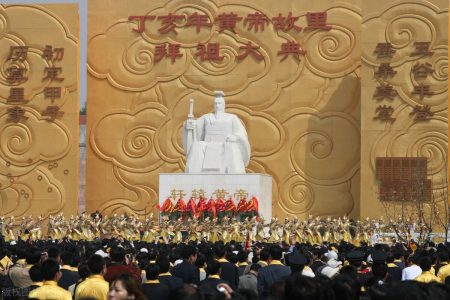
Ancestor veneration was tied to the idea that legitimate authority flows through lineage—which is why legendary figures like Huang Di, or the Yellow Emperor became revered as the ancestral founder of Chinese civilization.
Ancestor reverence in China is not peripheral—it is foundational to the culture and worldview. The earliest recognized ancestor of the civilization naturally becomes extremely important.
Chinese tradition often calls the Chinese people: “The descendants of Yan and Huang.”
Yan refers to Yan Emperor, another early culture hero. His importance is therefore symbolic and ancestral.
Huangdi represents:
- the first civilizing ruler
- the ancestor of the people
- the origin of cultural institutions
This is why emperors in later dynasties would offer sacrifices at his mausoleum to legitimize their rule.
Huang Di received the Mandate of Heaven, a concept later associated with early sage rulers. He is recognized as the founder of the Chinese people, the ancestor of Huaxia or the Han Chinese civilization. He established government, the calendar, music, medicine and technology.
If we accept the premise that Yellow Emperor represents the same historical figure as Abraham, the parallels between the two traditions become striking. Both stand at the beginning of a civilization’s remembered history as a patriarchal founder through whom a people trace their identity. Abraham is revered as the father of the covenant lineage of Israel, while Huangdi is remembered as the ancestral father of the Chinese people and the unifier of early tribes. In both traditions the patriarch serves as the origin point from which cultural continuity flows: Abraham’s descendants become the covenant nation through Isaac and Jacob, while Huangdi’s descendants form the Huaxia people who later develop into the Han Chinese civilization.
Another parallel lies in the way each figure is associated with the establishment of civilizational order under divine authority. Abraham’s story centers on a covenant relationship with God that defines the moral and spiritual framework for his descendants. Similarly, Huangdi is portrayed as a ruler who governs under Heaven’s authority and establishes the structures that allow civilization to flourish. Texts such as the Shiji describe him as a unifying leader who defeats rival powers such as Chi You and institutes practices of governance, medicine, and ritual that shape Chinese culture for millennia. In both narratives the patriarch stands not merely as a biological ancestor but as the conduit through which divine order enters human society.
Finally, both traditions preserve the memory of these figures through genealogical reverence and national identity. Abraham’s descendants maintain their lineage through scriptural records such as the Book of Genesis, where genealogies anchor Israel’s covenant history. In China, reverence for Huangdi is reinforced through ancestor veneration and imperial rites performed at his mausoleum, affirming him as the primordial ancestor of the Chinese people. Under this interpretive framework, the two figures occupy the same archetypal role: a patriarch called by Heaven who becomes the father of a people, the origin of a civilization, and the enduring symbol of a divinely ordered lineage.
Additionally, traditionally accepted dates place Huang Di in the same time period as Abraham circa 2500-2000 BCE. Lesser known details include that the gospel is embedded into the pictorial characters of the Chinese language. See: Gospel in China’s Pictorial Language.