

Aimee K
“To be or not to be” is one of the most famous soliloquies in literature, where Hamlet contemplates existence, life, and death.
I’d like to lay that soliloquy over another word:
Dispute
To have a dispute or not to dispute.
That has been the question.
Whether ’tis nobler among women to suffer
The slings and arrows of outrageous accusations,
Or to link arms against a sea of rumors
And in addressing them, conference. To vote—to rest,
It’s settled; and by an end to say we concede
The heart-ache and the thousand different emails
That decision is heir to: ’tis a consummation
Devoutly to be wish’d. To vote, in peace;
In peace, perchance to live—ay, there’s the rub:
For in that peace of Zion what pilgrims may come,
When we have shuffled off Babylonian chains,
Must give us pause—there’s the pot
That makes melt of so many nations.
For who would bear the wind and rain of winter,
The valley’s chill, the mountain’s contempt,
The pangs of misprised intention, the law’s ambiguity,
The insolence of nescience, and the spurns
That patient merit of nature takes,
When he himself might his acquittance make
With an open flame? Who would officiate or bless,
To kneel and plead under a sanctified life,
But that the dread of something after council,
The unconverted country, to whose proselytizing
No servant has gone, puzzles the will,
And makes us rather bear those disputes we have
Than fly to others that we know not of?
Thus humility doth make servants of us all,
And thus the pale cast of fear
suffuses in the native hue of resolution
And enterprises of great pith and moment
With this regard their currents turn awry
And yoke together in the name of God.
This is a continuation of my previous post on disagreement.

Boxed In: Controversy
How does Zion resolve disagreements without imposing authoritarian control? Especially when we can expect that Zion’s inhabitants will come from every corner of the world, culture and religious background.
Boxed In: Controversy
How does Zion resolve disagreements without imposing authoritarian control? Especially when we can expect that Zion’s inhabitants will come from every corner of the world, culture and religious background.
Is dispute acceptable?
Well, I suppose that depends on what you mean by “dispute.”
Previously I had focused on the two ways to resolve a disagreement: dispute and controversy. However, dispute actually has three forms whereas previously I only focused on one: the intransitive verb.
The application of this study may seem obvious to some in the context of women’s Zoom meetings to discuss councils and conferences. However, for my part I have a much greater interest in resolving the seven year dispute with my husband regarding the state and standing of the LDS church before God and the message delivered by a man by the name of Denver Snuffer, whom my husband thinks is a wolf in sheep’s clothing.



Dispute (intransitive; verb without object):
to engage in argument or debate, quarrel, squabble, bicker
a) She liked nothing more than to dispute with her fellow law students.
b) Mind you, Christ could have disputed, he could have corrected, he could have challenged every one of the ongoing religious and social conventions of his day…. How much of the gospel of Christ would not have been possible for Him to preach if He’d gone about contending?
Glossary: mutual agreementc) Then Paul, after the governor had beckoned unto him to speak, answered, Forasmuch as I know that you have been of many years a judge unto this nation, I do the more cheerfully answer for myself, because you may understand that there are yet but twelve days since I went up to Jerusalem to worship. And they neither found me in the temple disputing with any man, neither raising up the people, neither in the synagogues nor in the city; neither can they prove the things whereof they now accuse me.
This verb intransitive form of “dispute” is synonymous with contention. In fact, in many of the Book of Mormon to Covenant of Christ instances of contention were translated into dispute. Leaning on Schoolhouse Rock, a verb is an action word and the intransitive form of dispute is arguing, verbally, face to face.
In the third example the apostle Paul denies disputing with anyone. This is an important detail. Put that in your pocket for now. We’ll need it again shortly.
Dispute (noun) :
Disagreement or difference of opinion
a) Players were elated when the equal pay dispute was finally resolved.
b) Pray together in humility and together meekly present your dispute to me, and if you are contrite before me, I will tell you my part.
When dispute is a noun, it just is. Unlike most tangible nouns that are person, place, or thing, this kind of noun is an idea. It exists as a fact. There’s nothing happening between people who hold differing views. I tend to think that this neutralized form of dispute that we may take to the Lord.
Here you go, Lord. We can’t figure out if this is a horse or a frog. Could you please help us understand?
Dispute (transitive; verb with object):
The form of dispute that is a verb with an object we have someone calling into question some thing. It’s still an action, but rather than needing two to tango with each other, you have one person pointing at the thing and saying, “I disagree with THAT.”
Dispute (transitive; verb with object) : discuss object, to argue or debate about a topic, call into question an object
a) Historians dispute this claim, suggesting Raleigh could not possibly have discovered the potato in the places he visited.
b) And he was with them coming in and going out at Jerusalem, and he spoke boldly in the name of the Lord Jesus, and disputed against the Greeks, but they went about to slay him, which, when the brethren knew this, they brought him down to Caesarea and sent him forth to Tarsus.
c) And he [Paul] went into the synagogue and spoke boldly for the space of three months, disputing and persuading the things concerning the kingdom of God.
Buckle up your grammar belt and let’s take a closer look at the second example from scripture.
Paul was not disputing with the Greeks (engaging them personally), but disputing against them, which is to say, condemning the group for something; a false doctrine, an associated behavior or cultural practice.
I find the example still very tricky, so let me say that it would be like identity politics.
I can condemn a political ideology and cite bullet points on their platform that contradict ethical or moral principles. However, if your identity (i.e. your ego) is wrapped around this particular political ideology, you may personally feel attacked. I’m not disputing with you. I’m disputing the ideology. You can change your mind, and that’s what I’m hoping to do, honestly.
Remember earlier how Paul testified that he did not dispute with anyone (verb, intransitive)? Either Paul is a liar or there is a key difference between disputing with someone (verb, intransitive) and disputing an idea (verb, transitive). For the record, I don’t think Paul was a liar.
It’s OK to dispute an idea, an ideology, or any other thing.
Let's sit on the same side of this table to look at this thing and discuss. I'm not attacking you. We are on the same team. Let's figure this out together.
Objection #1: Everything I believe is already correct
People value what they think is true more than they value what IS true.
After you’ve chewed on that for awhile I recommend taking a quick look at the following comic by The Oatmeal. It applies to EVERYONE, so don’t get too cocky.
Objection #2: Conflict is Contention and ought to be avoided
Conflict avoidance might feel like a way to keep the peace, but in reality, it slowly erodes our freedom, authenticity, and emotional well-being. Each time we stay silent to avoid discomfort, we trade honesty for temporary relief. But over time, that choice builds walls between ourselves and others. Research shows that avoiding conflict can cause as much distress as constant arguing, while those who learn healthy communication enjoy better mental, emotional, and even physical health.
The following video explores how conflict avoidance traps people, why our brains perceive disagreement as danger, and practical, research-backed strategies to reclaim your voice, boundaries, and peace of mind.
Run-time: 18 minutes
Transcript
Hidden in the section below is the full transcript to the Conflict Avoidance video. If you prefer to watch, great! If you prefer to read or skim the transcript, expand the box below.
You’re sitting across from someone you care about. They just said something that hurt you. Your chest tightens. Your mind races through a hundred responses, but instead of speaking up, you smile and say, “It’s fine.” You change the subject. You swallow the words you really want to say. Later that night, you replay the conversation in your head. You imagine what you should have said. You feel that familiar knot of resentment growing tighter, and you wonder why you keep doing this to yourself. Sound familiar?
Here’s what’s happening: every time you avoid conflict to keep the peace, you’re trading away a piece of your freedom. Not your freedom in some abstract sense—your actual freedom to be yourself, to have authentic relationships, to make choices that reflect who you really are.
Here’s a statistic that might surprise you. According to research from psychologist Maline Bruce at St. Louis University, conflict avoidance is associated with psychological distress levels comparable to those who experience frequent conflict. In a study of over 1,400 adults, both the high-conflict group and the high-conflict-avoidance group reported significantly more distress than those who engaged in healthy conflict resolution. You’re not alone in this pattern. Most of us have learned to view conflict as something dangerous—something to escape. But what if I told you that by avoiding conflict, you’re not protecting yourself at all? What if you’re actually building invisible walls that keep you trapped, disconnected, and fundamentally unfree?
In today’s video, we’ll explore four hidden ways conflict avoidance is stealing your freedom. First, we’ll break down the surprising mechanisms that keep you silent even when it matters most. Then, we’ll uncover the evolutionary and neurological reasons why your brain treats disagreement like a physical threat. But most importantly, we’ll walk through six practical strategies—backed by psychological research—that you can start using today to engage with conflict more effectively. By the end, you’ll understand how facing conflict isn’t about becoming aggressive or confrontational. It’s about reclaiming your voice, your boundaries, and your authentic relationships—without requiring you to become someone you’re not.
Let me ground this in research before we go further. This isn’t about motivational talk. This is about understanding what science tells us about conflict and human psychology. Communication scholar Michael Roloff has documented how conflict avoidance creates what he calls “interpersonal issues that fester.” When conflicts remain unresolved and unaddressed, they either explode in dramatic confrontations or result in emotional suppression that damages our mental health.
Research from psychologist Brittany Speed and her colleagues at Stony Brook University found that assertiveness training—which teaches people to engage with conflict constructively—leads to significant improvements in depression, anxiety, self-esteem, and relationship satisfaction. Their comprehensive review of decades of research shows that the ability to express ourselves honestly while respecting others isn’t just a nice skill—it’s foundational to psychological health.
Richard Slatcher at the University of Georgia has shown something even more remarkable. His research on couples found that those who resolve disagreements using positive behaviors like humor and affection don’t just have better relationships—they have healthier cortisol patterns, which are linked to better overall physical health and potentially increased longevity. The message from neuroscience and psychology is clear: avoiding conflict doesn’t protect you. It quietly erodes your well-being from the inside out.
Let’s break down exactly how conflict avoidance undermines your freedom. There are four distinct ways this pattern operates.
First, conflict avoidance forces you to suppress your genuine needs and feelings. Every time you stay silent when something matters to you, you’re sending your brain a message that says your thoughts, your feelings, and your boundaries don’t matter as much as keeping the peace. Over time, this creates what psychologists call learned helplessness. You begin to believe you have no power to change your circumstances. According to research published in the Program on Negotiation at Harvard Law School, this pattern of suppression can lead to broken relationships, damaged reputations, and strained interactions across all areas of life.
Second, conflict avoidance creates emotional distance in your relationships. When you refuse to address issues that bother you, you’re not actually preserving the relationship—you’re creating a version of it that’s less authentic and less intimate. Psychologist Marisa Franco, who studies friendship and relationships, found that people who engage in healthy conflict are more popular, have greater well-being, and experience less depression, anxiety, and loneliness. The opposite is also true. When people avoid conflict, they often choose to distance themselves from others, which damages the very relationships they were trying to protect.
Third, unresolved conflict doesn’t disappear—it transforms. Research from St. Louis University shows that conflict avoidance leads to increased resentment, passive-aggressive behavior, and what’s called emotional leakage. The anger and frustration you suppress in one situation often spill out inappropriately in another. You might snap at your partner over dishes when you’re actually upset about work. You might withdraw from friends when you’re really frustrated with family dynamics. The energy it takes to contain these emotions exhausts your mental resources.
Fourth, conflict avoidance prevents personal growth. Brett Olson at Florida Atlantic University argues that conflict is actually one of the foundational building blocks of healthy relationships. When managed constructively, conflict helps us develop autonomy, individuation, and improved social skills. Without conflict, we can’t test our boundaries, clarify our values, or learn how to negotiate our needs with others. Avoiding conflict might feel safer in the moment, but it keeps us psychologically stuck—unable to develop the emotional maturity that comes from working through disagreements.
Each of these mechanisms compounds over time. The more you avoid, the more helpless you feel. The more helpless you feel, the more you avoid. This cycle doesn’t lead to peace—it leads to a quiet, suffocating loss of freedom.
Why do we do this to ourselves? Why does conflict feel so threatening that we’d rather sacrifice our own needs than face it? The answer lies in how our brains are wired. Your brain doesn’t distinguish between physical threats and social threats. When you anticipate a difficult conversation, the same neural systems activate as if you were facing physical danger. The amygdala—your brain’s threat detection system—triggers rapidly in response to potential social conflict. This activates your sympathetic nervous system, initiating the fight, flight, or freeze response. Cortisol floods your system. Your heart rate increases. Blood flow redirects to your muscles. Your mouth goes dry. All of this happens because your brain is treating the upcoming conversation as if it were a life-or-death situation.
From an evolutionary perspective, this makes sense. For our ancestors, social exclusion from the tribe could mean death. Being cast out meant losing access to resources, protection, and mates. Our brains evolved to be exquisitely sensitive to signs of social threat. But here’s the problem: that same neural wiring that kept our ancestors alive is now sabotaging our relationships and our freedom.
Your prefrontal cortex—which handles rational thinking and decision-making—gets overridden by the emotional brain during perceived threats. This is why it’s so hard to think clearly during conflict. Your higher reasoning centers are literally being suppressed by your brain’s ancient threat detection systems. There’s also a neuro-chemical dimension to this. When you’re in threat mode, your brain releases stress hormones that impair cognitive functions like reasoning, problem-solving, and memory retention—exactly the skills you need most during difficult conversations. So, the moment you need to be most articulate and thoughtful, your brain is actively working against you.
Social conditioning compounds these biological responses. Many of us grew up in environments where conflict was either absent or excessive. If you never saw healthy conflict resolution modeled, you literally don’t have the neural pathways built for it. Your brain doesn’t have a template for what constructive disagreement looks like. Or perhaps you grew up in a home where conflict was explosive and dangerous. In that case, your brain learned early that conflict equals trauma and avoidance equals survival.
Cultural factors play a role too. Many cultures emphasize harmony over individual expression. You might have internalized messages that being agreeable is more valuable than being authentic—that rocking the boat is selfish, that your discomfort matters less than others’ comfort. These beliefs operate beneath conscious awareness, shaping your behavior automatically.
Finally, there’s the reinforcement cycle. Every time you avoid conflict and nothing terrible happens immediately, your brain registers that as a success—avoidance gets reinforced. The anxiety you feel before confrontation gets temporarily relieved when you stay silent. That temporary relief, even though it leads to worse outcomes later, is enough to keep the avoidance pattern going.
Understanding these mechanisms doesn’t make conflict easier, but it does help you recognize that your fear isn’t evidence that conflict is genuinely dangerous. It’s evidence that your brain is following ancient programming that no longer serves you in the modern world.
So, how do you break free from this pattern? How do you start engaging with conflict in a way that builds freedom rather than fear?
Here are six research-backed strategies you can begin implementing immediately.
Strategy 1: Re-frame conflict as information, not threat. Before your next difficult conversation, remind yourself that disagreement reveals important data about the relationship. It shows you where boundaries need clarification, where needs aren’t being met, and where growth is possible. Psychologist Marisa Franco emphasizes that healthy conflict brings people closer when approached collaboratively rather than adversarially. Instead of thinking about winning or losing, think about what you and the other person can learn.
Strategy 2: Practice with lower-stakes situations. Don’t wait until you’re furious about something major to start speaking up. Begin with small things. If your coffee order is wrong, practice politely asking for it to be fixed. If a friend suggests a restaurant you dislike, express your preference. Research on assertiveness training shows that building this muscle with minor conflicts makes it easier to handle significant ones. Each small success rewires your brain slightly, creating new neural pathways that associate speaking up with positive outcomes rather than danger.
Strategy 3: Separate the person from the problem. When you need to address something, focus on the specific behavior or situation, not the person’s character. Instead of saying someone is thoughtless, describe the specific action that bothered you. This technique—supported by decades of conflict resolution research—prevents the other person from becoming defensive. It allows them to hear your concern without feeling attacked. It also helps you stay calm because you’re discussing observable facts rather than making judgments about someone’s nature.
Strategy 4: Own your emotional experience without blame. Use statements that start with your own feelings and needs. Say what you observed, how it affected you, and what you need going forward. This approach, validated by research from the Association for Behavioral and Cognitive Therapies, helps you express yourself assertively without aggression. You’re not attacking—you’re simply sharing your experience. The other person can hear this much more easily than accusations or demands.
Strategy 5: Prepare for the physical response. Since your body will react to conflict as a threat, develop techniques to calm your nervous system. Practice deep breathing before difficult conversations. During the conversation, notice when you’re becoming activated. Pause if you need to. It’s completely acceptable to say you need a moment to collect your thoughts. Research shows that managing your physiological response allows your prefrontal cortex to stay online, giving you access to your full cognitive abilities.
Strategy 6: Be willing to hear the other person’s perspective and acknowledge your part in the situation. Healthy conflict isn’t about proving you’re right—it’s about mutual understanding. If someone points out how you contributed to the problem and it’s valid, own it. Apologize if appropriate. This doesn’t mean backing down from your concerns. It means recognizing that most conflicts involve complexity on both sides. Psychologist Marisa Franco calls this reciprocity. When you approach someone with respect and willingness to own your part, they’re much more likely to respond the same way.
Let me add two more advanced strategies for those ready to go deeper.
Strategy 7: Set clear boundaries about how conflict should happen. You can tell someone you want to discuss something difficult, and you can request that you both stay calm and respectful. You can even say what you’re afraid might happen and ask for reassurance. This meta-communication—talking about how you’re going to talk—helps create safety for both people.
Strategy 8: Build conflict self-efficacy. This is your belief in your ability to handle disagreements. Start noticing when you successfully navigate difficult conversations, even small ones. Celebrate these wins internally. Keep a record if it helps. Over time, you’ll build evidence that conflict doesn’t destroy you or your relationships. This evidence gradually overrides the fear-based programming in your brain.
Remember, none of these strategies require you to become someone different. You don’t need to be loud or aggressive or confrontational. Assertiveness, as research shows, is about expressing yourself respectfully while also respecting others. It’s not about domination—it’s about honest communication. It’s about claiming your right to have needs, opinions, and boundaries without apologizing for your existence.
Freedom isn’t the absence of conflict. Freedom is the ability to speak your truth, set your boundaries, and maintain your integrity even when it’s uncomfortable. Every time you avoid conflict to keep the peace, you’re trading authentic freedom for the illusion of safety.
The research is clear. People who learn to engage with conflict constructively don’t just have better relationships—they have better mental health, better physical health, and greater overall life satisfaction. They’re not more aggressive or difficult. They’re simply more honest, more connected, and more fully themselves.
This doesn’t mean seeking out conflict or being combative. It means no longer sacrificing your voice to avoid discomfort. It means recognizing that disagreement is a normal, necessary part of any genuine relationship. It means trusting yourself enough to believe that your perspective matters, even when others disagree.
The path forward starts with one small step—one moment where you choose honest discomfort over false peace. One conversation where you say what you actually think instead of what you believe others want to hear. One boundary you set even though it might disappoint someone.
Here are three questions to sit with: Where in your life right now are you staying silent when you need to speak? What would change if you believed that your voice, your needs, and your boundaries were just as important as maintaining harmony? And what might freedom actually feel like if you stopped being afraid of conflict?
The choice, as always, is yours. But remember: the cost of silence compounds. The freedom you gain from honest communication expands. Which future are you building with today’s choices?
How to proceed?
The Lord gave explicit instruction on how to resolve conflict.
Study to learn how to respect your brothers and sisters and to come together by precept, reason, and persuasion, rather than sharply disputing and wrongly condemning each other, causing anger. Take care how you invoke my name.
Let’s tackle the action items one at a time. Feel free to look up each word in your own favorite dictionary. I employed three dictionaries for this exercise: 1, 2, 3
RESPECT′, verb transitive [Latin resp ectus]
To hold in esteem or honor.
To show regard or consideration for.
To view or consider with some degree of reverence; to esteem as possessed of real worth.
Esteem for or a sense of the worth or excellence of a person, a personal quality or ability, or something considered as a manifestation of a personal quality or ability.
How can I respect someone with whom I have a disagreement? Not merely show respect, but actually respect them in deed.
Respect means that I must notice them with some particularity and recognize their importance. To regard them with affection, kindness, and concern and consider them seriously. To show deference and esteem them as valuable.
PRE’CEPT, noun
- In a general sense, any commandment or order intended as an authoritative rule of action; but applied particularly to commands respecting moral conduct.
- A command or principle intended especially as a general rule of action
- A commandment or direction given as a rule of action or conduct.
Precepts are the commandments or other explicit revelation given on a particular subject.
REASON, noun
- The cause, ground, principle or motive of any thing said or done; that which supports or justifies a determination, plan or measure.
- a statement offered in explanation or justification
- a sufficient ground of explanation or of logical defense. Especially: something (such as a principle or law) that supports a conclusion or explains a fact.
- the thing that makes some fact intelligible: cause
- sufficient cause, as produced by a situation that makes an act, feeling, etc., obviously proper or appropriate.
The reasons we act on information in a certain way depend upon our unique experience.
PERSUA’SION, noun s as z. [Latin persuasio.]
1. The act of persuading; the act of influencing the mind by arguments or reasons offered, or by any thing that moves the mind or passions, or inclines the will to a determination.
Precepts tell you what to do.
Reason explains why you do it.
Persuasion motivates so you want to do it.
Persuasion: Aristotle's Rhetoric

After sharing my ideas from Boxed in Controversy someone asked me how the controversy strategy was applicable in resolving day-to-day disagreements in a marriage.
uhh…. [long pause]
Well, it’s really not the best approach for the daily minor disagreements in marriage, but rather meant for addressing ongoing disagreement in a larger community.
My most prolific writing occurs when I’m not welcome to have the conversation. Rather than stewing in frustration I write out the controversy. This has been a productive way to organize my thoughts with supporting evidence for a future invitation that honors my family’s agency.
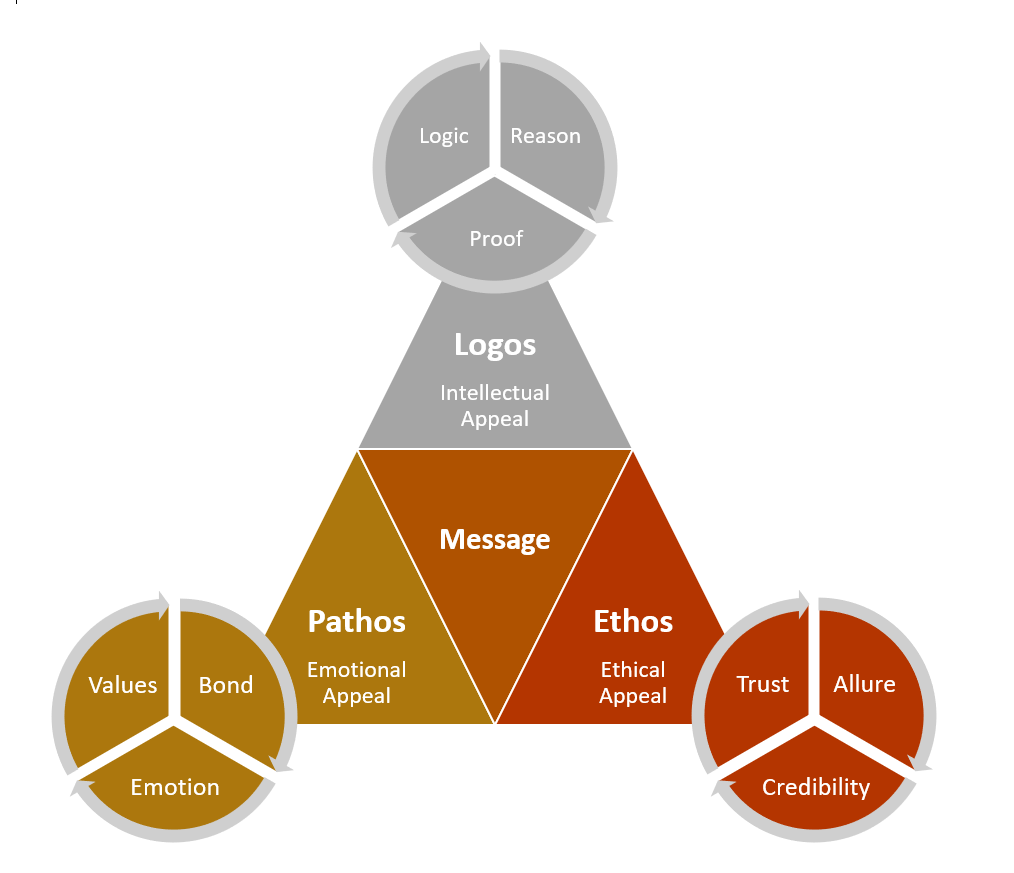
But the question really got me thinking so I went looking for persuasion theory and stumbled across Aristotle in the process. His model looks something like this:
Ethos – Do you know me well enough to trust me?
Pathos – Do you feel safe and emotionally connected so we can have this conversation?
Logos – Let’s take this one step at a time and reason through it logically
Kairos – Is this the right time and place to have the conversation?
Telos – What’s the ultimate goal here? Is it to “win” the argument or is it to achieve something greater?
Although Aristotle wrote Rhetoric in the 4th century BC it has become the foundation of nearly all subsequent treatises on persuasion.
Ethos - Character & Composure
Who you are at your core adds to ethical persuasion.
Let no man despise your youth, but be an example of the believers — in word, in conduct, in charity, in spirit, in faith, in purity.
Does the person you are talking to know you? Do they have proof of your character?
Wherefore, by their fruits you shall know them.
Matthew 7:20 KJV
Doing what you say creates confidence and credibility in the message.
Wherefore, lay aside all filthiness and excess of wickedness, and receive with meekness the grafted word, which is able to save your souls. But be doers of the word and not hearers only, deceiving your own selves, for if any are a hearer of the word and not a doer, he is like unto a man beholding his natural face in a mirror, for he beholds himself and goes his way, and immediately forgets what manner of man he was. But whoever looks into the perfect law of liberty and continues therein, he being not a forgetful hearer but a doer of the work, this man shall be blessed in his deed.
Actually being and not just superficially acting some way when someone is watching is imperative for moral ethos. God knows the difference.
They [the angels] are obedient to Him, to minister according to His commands, revealing themselves to those of strong faith and of a firm mind in every form of godliness.
Moroni 7:30
Pathos - Empathy & Connection
Pathos is the appeal which persuades on an emotional level. Certainly people can be manipulated through negative emotional triggers such as guilt, fear, anger or pity.
Positive emotions can likewise be fabricated through brand & sales tactics like “HeartSell.”
Our unique strength is the ability to touch the hearts and minds of our audiences, evoking first feeling, then thought and, finally, action. We call this uniquely powerful brand of creative “HeartSell”® – strategic emotional advertising that stimulates response. [Bonneville, 2014]
The LDS church and its marketing efforts seem to acknowledge that these warm fuzzy feelings are psychologically induced.
Barf.
So how does one approach pathos in the right way?
…and are willing to bear one another’s burdens, that they may be light, yea, and are willing to mourn with those that mourn, yea, and comfort those that stand in need of comfort
Mosiah 18:8-9
Showing up when life gets messy or difficult connects people on an emotional level. It builds empathy, understanding, compassion and genuine interest. Love is demonstrated in action rather than being given lip service.
Something else to keep in mind: When people interact it produces different chemical responses depending on the situation.
If you perceive an interaction as a threat, your body releases adrenaline, the flight or fight hormone and follows with cortisol to sustain the state of stress. This biological reaction shuts down higher reasoning. Although fear, intimidation, or guilt can sometimes produce short-term compliance, using negative emotional triggers to control others is manipulative and contrary to the order of heaven.
Positive interactions, on the other hand, produce four hormones that contribute to happy emotions.
Oxytocin is released with social bonding involving physical touch such as hugging. Endorphins are released with activities like exercise or laughing. Serotonin is accessible through sunlight, gratitude, breathing, meditation, and prayer. Dopamine is the reward/motivation hormone, which can be achieved through food and music.
Food, music, activities, hugs, laughter, gratitude and prayer…GOSH those all sound like elements of a wonderful conference. But I digress…
We also get dopamine through recognition or compliments, but these teeter on the edge of flattery, which is warned against in scripture:
Flattery also is a deadly poison.
T&C 138:17
God is a perfect judge and we do have some few examples of His approval. And we really ought to be seeking His favor rather than that of anyone else.
Blessed art thou… [Lehi/Nephi/Sam/Alma/Joseph]
However these are exceptions and not the rule. The rule is that if God loves you, expect to be chastised.
As many as I love, I rebuke and chasten; be zealous therefore and repent.
Revelation 3:19
Logos - Logic & Clarity
Logos is the intellectual appeal of the persuasive argument and includes facts, figures, structure, credible evidence, proofs and appeal to principle and the laws that govern reality.
Principles are the eternal truths that comprise the “spirit of the law”.
The logical “muscles” behind persuasion is deliberation and refutation. It’s laying out options and consequences.
Now, when a man reasons he is understood of man because he reasons as a man; even so will I, the Lord, reason with you that you may understand.
T&C 36:3
Kairos - Patience & Timing
Kairos is a bonus portion of Aristotle’s Rhetoric, which is to mean: the right moment; time & place.
A marriage proposal might be in order, but ought it to be done in the checkout line at Costco or at sunset after a romantic evening out? When and where you make your persuasive appeal can have just as much impact as the substance of your position.
A wonderful example of patience and timing is captured in the vision related by Denver Snuffer and canonized in T&C 163.
I waited on the Lord and he brought me here safely.
There are some things that just can’t be rushed.
Telos - What's the ultimate goal?
In a community or in a marriage what is the ultimate goal when approaching conflict resolution? Is it Zion? Is it exaltation? If we lose sight of those then maybe the battle isn’t worth winning. Good generals strategize to win the war.
What’s the war? I believe it is an extension of the war in heaven and salvation itself is on the line. We are overcoming the Natural Man within each of us.



Conclusion
It’s OK for a dispute (noun) to exist. It’s OK to dispute something you disagree with (verb transitive). It is not OK to dispute with a person (intransitive, verb without an object) which is synonymous with contention.
Avoiding a dispute (noun) may feel safer in the moment, but it ultimately restricts our freedom, weakens our relationships, and harms our emotional well-being. Oftentimes our brains react to disagreement as if it were physical danger, pushing us into silence and self-protection instead of growth. But when we learn to address a dispute with honesty, calmness, and compassion, we reclaim our voice and deepen connection with others. Choosing truth over false peace is how we build stronger community and more authentic relationships.
Resolution is possible, but it’s going to take more time, effort and personal investment than we are currently accustomed to or than is modeled anywhere in our present culture.
Study to learn how to respect your brothers and sisters and to come together by precept, reason, and persuasion, rather than sharply disputing and wrongly condemning each other, causing anger. Take care how you invoke my name.