

Aimee K
Disclaimer
I will give a disclaimer that all of the thoughts below are my own and do not represent anything or anyone other than my own musings. If you find value in what I’ve written — great! Take it with a grain of salt. If you think I’m off my rocker, no problem. I probably am.
From the galls of oaks one might distill ink, and thus write a new story; or cast a spell, and when a story casts a good spell, we call that, a Gospel. The nature of words is to grow into a tangle, especially if untended; or if attended to briefly by zealous and foolish gardeners.
2015.08.01 The Mormon Legal Mind – Sunstone Discussion with Denver Snuffer Transcript v1.2
I am aware that this attempt to wrestle meaning out of “oaks” may be sorry evidence that I am a zealous or foolish gardener. However, I sincerely pray that’s not the case.
Howl, O you oaks of Bashan, for the forest of the vintage has come down.
Zechariah 11:2 KJV
For they shall be ashamed of the oaks which you have desired, and you shall be confounded for the gardens that you have chosen.
Isaiah 1:29 KJV
The day of the Lord will come against those acting like the cedars of Lebanon, lofty and proud, and like the oaks of Bashan, against the high mountains…
2 Nephi 12:13-14
Relevant Old Testament
Latter-Day prophecy follows a pattern. It’s so precise that many of the Old Testament books that often get overlooked suddenly become incredibly relevant; recognizing in stark clarity that what is unfolding in breaking news was prophesied thousands of years before.
Obviously Isaiah falls into this category. But how often do we look at Zephaniah, Zechariah, or Habakkuk?
Background: Harbinger
Johnathan Cahn penned an inspired body of work in his book, The Harbinger. September 11th was a shot across the bow. A warning to the modern covenant people to repent. At the center of his treatise was the following verse in Isaiah:
…that say in the pride and in the stoutness of heart, The bricks are fallen down, but we will build with hewn stones; the sycamores are cut down, but we will change them into cedars.
Isaiah 9:10 KJV
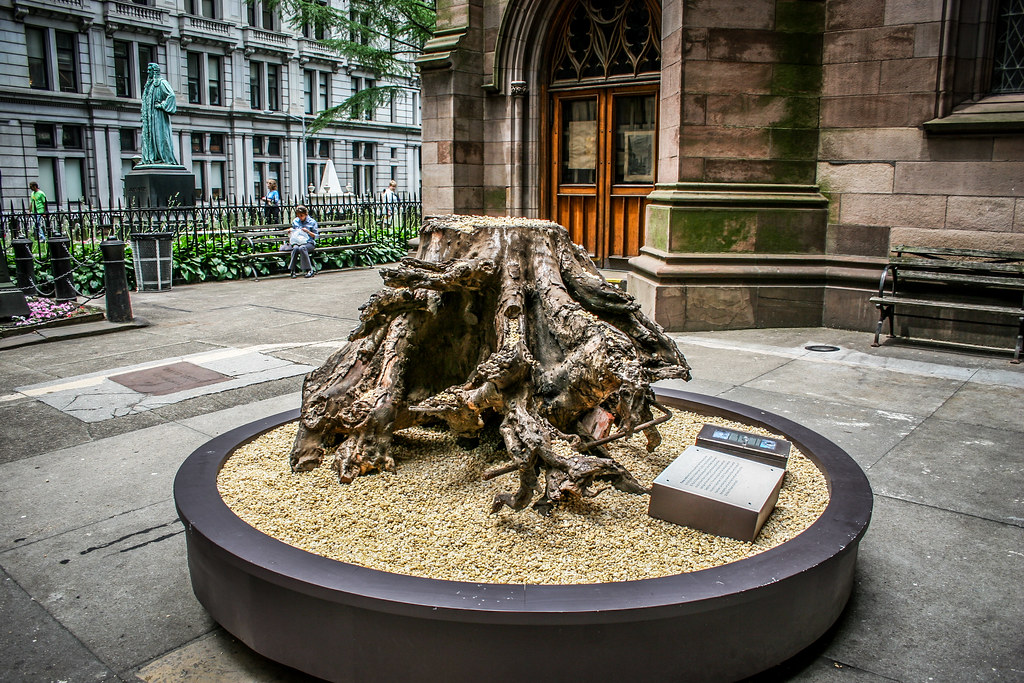
The “bricks” of the Twin Towers fell after a terrorist attack against the United States. Rubble filled the streets damaging several blocks of neighboring buildings. In the courtyard of St. Paul’s Chapel, the block across from the World Trade Center, a sycamore tree shielded the chapel from any major damage, but itself was destroyed in the process.
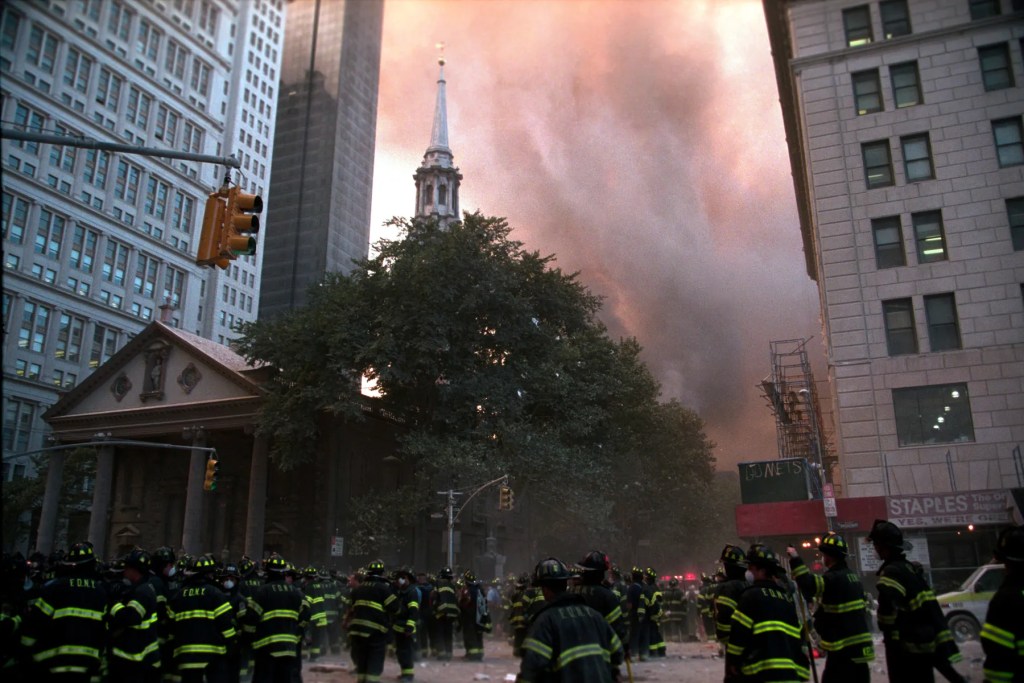
It was in the St. Paul’s Chapel where George Washington, after his inauguration, offered a prayer for providence as the first official government act under the new Constitution.
“Almighty God; We make our earnest prayer that Thou wilt keep the United States in Thy holy protection; that Thou wilt incline the hearts of the citizens to cultivate a spirit of subordination and obedience to government; and entertain a brotherly affection and love for one another and for their fellow citizens of the United States at large.
And finally that Thou wilt most graciously be pleased to dispose us all to do justice, to love mercy, and to demean ourselves with that charity, humility, and pacific temper of mind which were the characteristics of the Divine Author of our blessed religion, and without a humble imitation of whose example in these things we can never hope to be a happy nation. Grant our supplication, we beseech Thee, through Jesus Christ our Lord. Amen.”
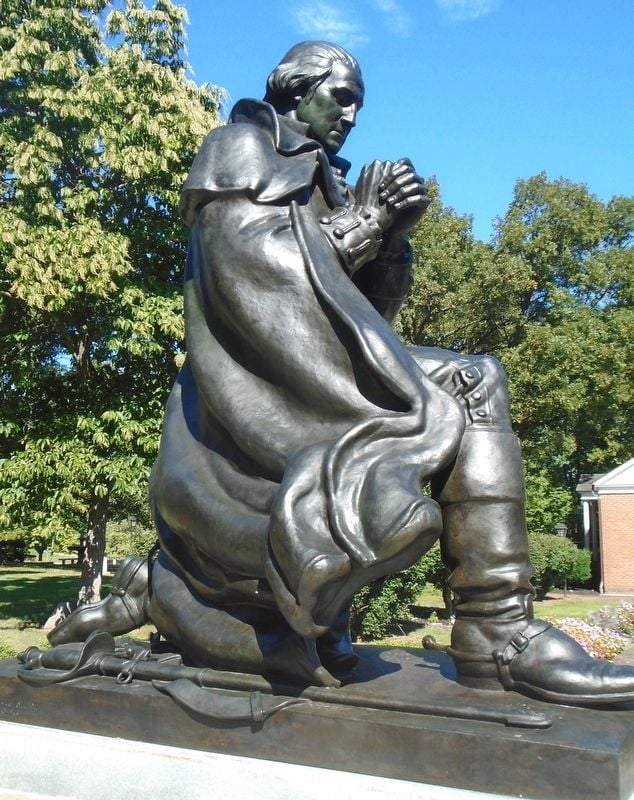
Washington dedicated the nation to God, asking for protection with acknowledgment of His sovereignty and dependence upon His favor.
A covenant was established — not by God’s decree as with ancient Israel, but by man’s voluntary act of consecration.
Johnathan Cahn
Violation of God’s law necessarily withdraws His protecting hand. This has been and always will be the case.
Israel’s protective hedge was broken down in approximately 734 BCE when the first Assyrian incursion attacked northern Israelite cities. Rather than repent, they responded in pride.
The bricks are fallen down, but we will build with hewn stones; the sycamores are cut down, but we will change them into cedars.
Isaiah 9:10 KJV
They’d rebuild stronger! They’d replant better trees!
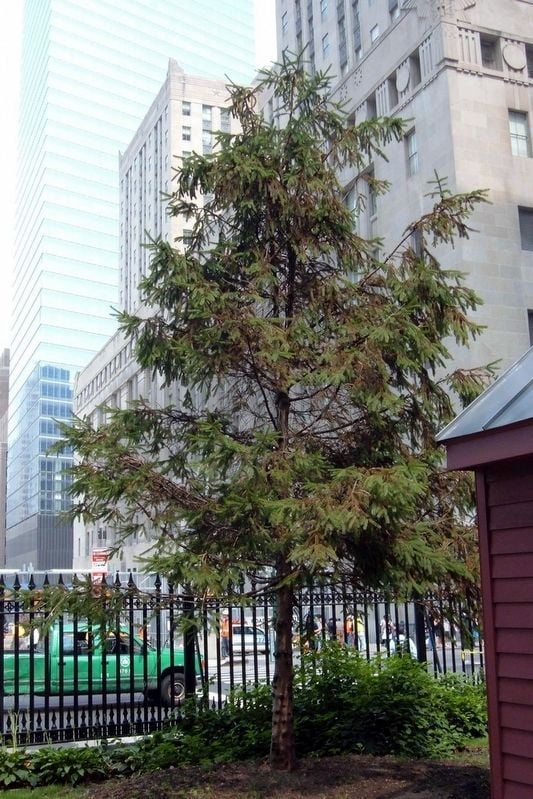
As if channeling Israel’s defiant response recorded in Isaiah 9:10, on 22 November 2003 the Tree of Hope, a 21-foot cedar, was ceremonially planted in the place where the original sycamore in St. Paul’s chapel courtyard had stood.
This Ground Zero Tree of Hope will be a sign of the indomitable nature of human hope…The Tree of Hope is planted in the very spot where the 60 year old Sycamore stood the morning of September 11, 2001.
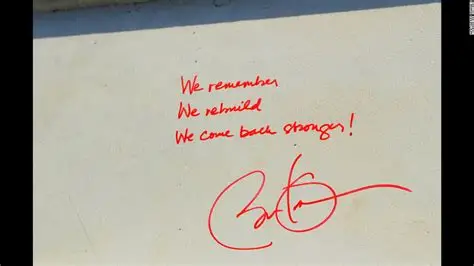
What’s more…On 02 Aug 2012 President Barack Obama and Michelle Obama signed the upmost structural beams of the One World Trade Center with the words, “We remember. We rebuild. We come back stronger.”
Echoing not the exact words but certainly the sentiment of Isaiah 9:10.

Unfortunately, the Tree of Hope died in August 2014. If the tree truly was a sign of the “hope” we have as a nation, we ought to consider our state very dire indeed. The signed beam at the top of the One World Trade Center remains intact… for now.
What Comes Next?
Roughly twelve years after Israel’s protective hedge was broken down, Assyria completed their conquest and deported Israel’s northern population (722 BCE). This was the year the northern ten tribes were carried away into exile and became lost.
Isaiah
Let’s first look at the condition of the covenant people prior to their destruction in the Assyrian conquest. I am citing Isaiah 1:4 RE (1:21-31 KJV), broken into parts with commentary.
How the faithful city has become a harlot!
The Lord often compares covenant people to a wife and Himself to the husband; yet when the convent is broken the “wife” turns aside as a harlot, chasing after other gods.
It was full of judgment; righteousness lodged in it, but now — murderers.
Abortion is the leading cause of death in the US. “The United States has killed primarily in support of sexual gratification, hedonism and as an accepted form of birth control. Every one involved will be held to account for killing.” (source) All three of the abortion clinics in Utah are in its capital Salt Lake City.
Your silver has become dross,
Silver is often associated with redemption in the scriptures. Dross is the impurity that is separated from silver during the refining process and in scripture serves as a metaphor for moral and spiritual corruption.
…your wine mixed with water,
Watered down wine is weak but worse yet, permanently compromised. You cannot un-dilute wine. Consider too that in the LDS church the ordinance prayer on the sacramental wine has changed the word “wine” into “water”. Mainstream LDS don’t even recognize this as a deviation from the explicit scriptural instruction.
…your princes are rebellious and are companions of thieves. Everyone loves bribes and follows after rewards;
Strong’s Concordance “prince” H8269: Captain, chief, ruler, governor, keeper, principal, general, lords, steward.
Article on Governor Cox Corruption Lawsuit. Just sayin’…
…they judge not the fatherless, neither does the cause of the widow come unto them.
Here “judge not” means to withhold justice. I’m over here asking myself, Who are the fatherless? Then I’m reminded of another important question: Where are the 300,000 unaccompanied migrant children that have gone missing?
The Lord responds to Israel’s sorry state:
Therefore says the Lord, the Lord of Hosts, the Mighty One of Israel, Ah, I will ease myself of my adversaries and avenge myself of my enemies, and I will turn my hand upon you, and purely purge away your dross, and take away all your tin.
How is dross purged from the silver? Through flame. It’s metaphorical for trials and hardship. Often literal as well depending on the situation.
Tin looks an awfully lot like silver, but lacks it’s purity and strength. Tin gives a false appearance of value. Tin will burn off or run out when the ore is heated. Pure silver remains solid until the impurities are gone.
And I will restore your judges as at the first, and your counselors as at the beginning. Afterward, you shall be called the city of righteousness, the faithful city. Zion shall be redeemed with judgment and her converts with righteousness.
Well, there’s something to look forward to!
And the destruction of the transgressors and of the sinners shall be together, and they that forsake the Lord shall be consumed.
Transgression is wilful disobedience. Sin misses the standard of perfection. The original Greek hamartia means “to miss the mark” and is a term used in archery. Sin occurs through weakness, ignorance or human frailty. After sufficient time is given to repent the reasons we did not will not matter. Both transgressors and sinners shall be together.
For they shall be ashamed of the oaks which you have desired, and you shall be confounded for the gardens that you have chosen. For you shall be as an oak whose leaf fades, and as a garden that has no water.
The oaks of Bashan, renowned for their strength and beauty, were living symbols of wealth, prosperity and national glory. They were used for oars (Ezk 27:6), shipbuilding and by extension facilitated trade. The hardwood was used locally for furniture, tools, and contributed to palatial and temple carpentry alongside cedars from Lebanon.
In scripture the oaks of Bashan are used as metaphors of strength, pride and human grandeur that would be humbled by God.
And the strong shall be as tinder, and the maker of it as a spark; and they shall both burn together, and none shall quench them.
The strong are the powerful, the self-reliant, the idol. The strong appears mighty, impenetrable, unconquerable; but is really just highly combustible. The “maker of it” is whoever fashioned “the strong”; whoever built this idol and illusion of strength. Both the strong and those who made it will burn together.
Zechariah
Zechariah was written in a different historical period than Isaiah, but both the describe the same spiritual cycle: pride, divine warning and national destruction. Isaiah writes prior to the Assyrian conquest; Zechariah two hundred years later during the time of the reconstruction. Both use trees in their metaphorical language and prophecy.
In this next part we will be considering Zechariah 1:30 RE (11:1-6 KJV)
Open your doors, O Lebanon, that the fire may devour your cedars. Howl, fir tree, for the cedar is fallen, because the mighty are spoiled.
The Assyrian invasion was long since over. But Zechariah seems to lean on Isaiah’s earlier imagery in his forward looking warnings of (presumably) the Roman destruction. The cedar tree that was planted afterwards to replace the fallen sycamore? It is burning. The fir tree, looks on in horror, knowing it is next.
Howl, O you oaks of Bashan, for the forest of the vintage has come down.
This is poetic language to convey that the entire forest is cut down and stripped bare. It’s a forest being reaped; harvested in it’s entirety. The entire structure of power and prosperity has fallen.
There is a voice of the howling of the shepherds, for their glory is spoiled, a voice of the roaring of young lions, for the pride of Jordan is spoiled.
Who are the shepherds? They are the leaders of the church.
Thus says the Lord my God: Feed the flock of the slaughter, whose possessors slay them and hold themselves not guilty. And they that sell them say, Blessed be the Lord, for I am rich.
This describes a flock that’s being fattened for the kill. But until that time comes, the Lord is asking that they are cared for and fed. God is not expressing cruelty but lament. The people are so spiritually lost they don’t recognize the danger. The flock is being consumed and abused by those who were supposed to protect and care for them. Those who kill the sheep from don’t even consider themselves to be guilty. When they sell the Master’s lambs they bless the name of their lord as they add to their own coffers. That’s a dark path to wander down. Proceed with caution. If you know, you know.
And their own shepherds pity them not. For I will no more pity the inhabitants of the land, says the Lord, but behold, I will deliver the men, every one into his neighbor’s hand and into the hand of his king. And they shall smite the land, and out of their hand I will not deliver them.
That ends the RE verse in Zechariah. The shepherds (leaders of the church) have no pity for the flock (trusting members of the church). And when the Lord of Hosts comes neither will He pity the inhabitants of the land. The last part reminds me again that the wicked shall destroy the wicked (T&C 157:65).
And it shall come to pass among the wicked that every man that will not take his sword against his neighbor must needs flee unto Zion for safety
D&C 45:68
Reading one verse beyond this one containing the oaks reference, we next find:
Three shepherds also I cut off in one month. And my soul loathed them, and their soul also abhorred me.
Zechariah 11:8 KJV
Bishop Koyle made a similar prophecy: “Near the time of the end, many of the General Authorities will become quite old. Troubles will start when three leaders will die in close proximity to one another. The new replacements will not be able to hold the Church together.”
Maybe something to keep in mind.
Second Nephi
I’ve dissected two of the oaks verses from the Old Testament. Here is a third from the Book of Mormon that has been authoritatively translated into modern English. I present it below without commentary.
You wicked ones, hide yourselves deep in the rock and bury yourselves in the ground before the terror of the Lord and His glorious majesty!
The Lord alone will be exalted in that day.
For the Lord of Hosts has planned a day against all the proud and arrogant, against everyone who thinks themselves elect; and they’ll be brought down.
The day of the Lord will come against those acting like the cedars of Lebanon, lofty and proud, and like the oaks of Bashan, against the high mountains, and the lofty hills, and against all the arrogant nations, and every defense barrier, and every fenced wall, and all the ships of Tarshish and other ships of the sea.
For mankind’s conceit will be humbled and their pride brought down, and the Lord alone will be exalted on that day.
And all the idols will vanish.
They’ll cower in caves of the earth, for the fear of the Lord will fill them with dread, and His majesty will overwhelm the earth.
At that time, mankind will throw away their idols of silver and idols of gold, which they worshiped, to the places where moles and bats are found, to then hide in the gaps of the rocks and the lonely canyons; for fear of the Lord will fill them with dread, and His majesty will overwhelm the earth.
Stop glorifying mankind, who only have breath in their nostrils, for what basis is there to admire them?
Shallow Roots
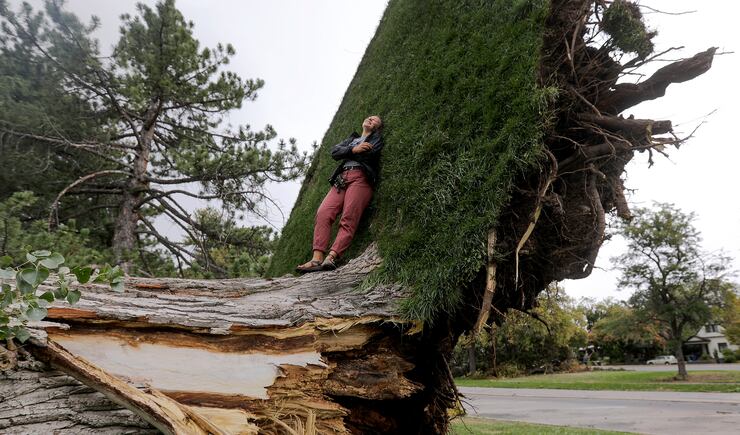
As a reminder there are old growth trees that may look very sturdy and strong. But as recently as September 2020 ninty mile per hour winds demonstrated to those in Utah valley that many of their trees did not have deep roots at all.
Conclusion
The references to the oaks of Bashan serve as a reminder of the transient nature of man’s tenure and the ultimate authority of God over creation. What is exalted in the eyes of men will be brought low by divine judgment.
The destruction of OAKS seems to be a central theme in God’s final judgment of a wicked people who have been soundly warned. We’ve already seen the modern harbingers echoing Isaiah’s warnings unfold in our day. When OAKS are set up front and center, I suspect we are very close indeed.
Post Script disclaimer
I should clarify that searching for “oaks” (plural) returns these scriptures whose themes reflect calls to repentance amidst damning pride.
There are plenty of “oak” references (singular) where God has met people and established covenant. “The oak tree serves as a metaphor for those who trust in God, finding refuge and protection under His shadow, and continually growing and unfolding in spirituality.” [source]
Because the battle that is already upon us, is going to require valiance. Cowardly, effeminate, hen-like behavior, can never, ever obtain the promises of God. Christ asked, “What went ye forth to see? A reed shaken in the wind?” Is that what you want? Because that isn’t who the Lord sends. Oaks,, not reeds, respond to His call. I don’t think John the Baptist cried on demand. And Zion isn’t a bank.




This Post Has 2 Comments
I really enjoyed reading this. I also haven’t heard Bishop Koyle quoted in a really long time so that was kind of a nice blast from the past.
Great commentary and analysis! I’ve always wondered about the various trees metaphors in these prophesies. Your clarification fits very well. Thanks
“When OAKS are set up front and center”… hilarious. Couldn’t agree more.
And yes, it was good to hear from Bishop Koyle, too. I doubt he was right about everything, but I believe he was likely correct on many.