
Aimee K
What is?
What is a Principle? How is it different than a Commandment? What about Doctrine? How is that different than an Ordinance? What’s a precept, a tenant, or a law?
There’s been a lot of discussion about what a principle is. And honestly, you could take any topic and say Principles of XYZ and there would be something there of substance.
Principles of economics
Principles of cooking
Principles of engineering
Principles of art and music
Principles of geometry
I guarantee the list is endless.
A principle defines predictable structure, and within that structure there will be an infinite number of ways that the principle will be expressed. But what makes something a principle is its consistency and inherent truth. Principles are true regardless of the situation or circumstance. They are observed.
Principles can be understood but never fully explained or expounded. You could have a lengthy discussion on the principle of agency, for example, and after weeks and months, though understanding increases, you haven’t fully defined AGENCY. #truestory
What I’m really after are the governing principles over literally everything; the architecture of the universe. I want to know the principles that define reality in a way that I can at least wrap my arms around. Is that even possible? I have a modicum of hope that it is, given the mandate to write a Statement of Principles.
I sent out an open invitation to brainstorm, but alas, for many, interest has waned.

Definitions
Principle – an underlying pattern of reality that is true regardless of belief, agreement, or enforcement. Natural law that has predicable effect.
Tenet – any opinion or interpretation that a person believes or maintains as true.
Now understand, the fact that I’m over here trying to explain what a principle is also fits under the definition of a tenet, unless I just so happen to get it right. Except someone might call my principles a tenet especially if they disagree with the premise. Whether or not you and I agree on what will follow is immaterial to the reality of what is.
Commandment– An authoritative order, charge, precept or injunction given as a rule of action, especially as to personal conduct.
Law/Rules – the governance of mortal institutions that may or may not align with natural law, morality or commandment
Commandments can be broken. Therefore, a commandment can’t also be a principle. However, what commandments do is orient us toward a principle.
Good laws of the land embrace commandments and attempt to codify natural law. However, not all laws are moral. Therefore it is possible for a law to contradict a commandment.
Ordinance – An outward, authorized act that binds the agent in a covenantal relationship.
Now as for doctrine….
Listen carefully to what I tell you: I will declare to you My doctrine. This is My doctrine, and it is the doctrine that the Father has given to Me: I testify of the Father, and the Father testifies of Me, and the Holy Ghost testifies of the Father and Me. I also testify the Father commands all people everywhere to repent and believe in Me. And anyone who believes in Me and is baptized will be saved, and they are who will inherit God’s kingdom. But anyone who doesn’t believe in Me and isn’t baptized will be damned. In truth I tell you this is My doctrine, and I testify of it from the Father. Anyone who believes in Me also believes in the Father, and the Father will testify to them of Me, since He will visit them with fire and with the Holy Ghost (3 Nephi 5:9 CE).
The Doctrine of Christ is very narrow which came in handy because I could use that as my model to fully figure out what doctrine actually means. Contrary to the Webster’s Dictionary doctrine is not JUST a set of teachings. And what Christ teaches is not limited to the Doctrine of Christ. Doctrine also includes commandments, ordinances, and promises.
This is His doctrine. This is the power of redemption. This is the way the Holy Ghost is obtained. This is not all of Christ’s teachings, tenets, precepts, covenants, commandments, or principles, but it is all of His doctrine.
There is false doctrine, doctrines of men, and doctrines of devils. “They teach for doctrines the commandments of men.”
I present: a bunch of old fuddy-duddies telling everyone that girls can’t wear more than one set of earrings and certain blouse tops give you porn shoulders. Well, anything to make their righteousness obvious and external. [insert eye roll] Whatevs…
I expect that the doctrines of devils might include ordinances that involve selling your soul to them, or something along those lines. Eek.
I recognize that there are multiple elements that compromise doctrine across multiple categories. Doctrine is both like a roadmap and a recipe. It’s very specific and finite. The Doctrine of Christ is the recipe for salvation. Unlike the doctrines of men that mimic a form of godliness, the Doctrine of Christ actually has authoritative power to deliver.
Doctrine – teaches, gives commands, offers ordinances, and makes promises.
Definitions definitely help! But where do we start when trying to discover and organize principles?
Christ’s answer when asked which was the greatest commandment gives us a clue as to the starting point. The greatest of all commandments is to love God; and second is to love our neighbor. However, it is possible to not love anyone. That’s how commandments get broken, you see.
Echoing the question posed to Christ: What’s the first and greatest principle? If the greatest commandment reflects the greatest underlying principle then it must be about love.
Consider for a moment that if LOVE is a principle, it exists whether you accept love, give love or believe in love at all.
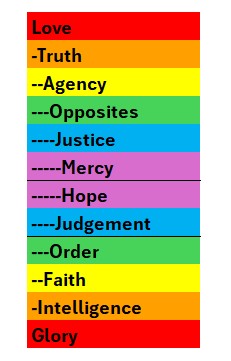
Exploring principles with this as my starting point and going on to the next immutable truth a framework began to take shape. I’ll give you a preview below. Something I’d also like to point out is that not only do the commandments seat comfortably under these principles, so do elements of the Doctrine of Christ. Even more interesting is that they form a chiasmus structure that validate one another. Meaning, similar to the organization and structure of the periodic table of elements and orbital rings, I can tell if I am missing anything and where it should go.
I teach them correct principles and they govern themselves.
—Joseph SmithThe Lord’s Holy Order is not designed to impose rule, control, or assert dominion over the unwilling. It is designed to teach correct principles and then let those who are taught govern themselves. The Holy Order empowers and frees. It assumes the individual will decide to give heed to what is taught.
—The Holy Order, Part II
Love
This is the essence of Godliness. The first and greatest principle is this: God is love. Not only that, but everything and everyone is connected. We are bound in relation to each other and nothing and no one exists in isolation.
Beloved, let us love one another, for love is of God, and everyone that loves is born of God and knows God. He that loves not knows not God, for God is love.
—1 John 4:8
What is inside you, sustaining you from moment to moment, is God.
What organized you and keeps you intact, moment to moment, is God.
What lies at the deepest core inside you is God.
What you should be trying to regress back to, and find within yourself, is God.
–Chiasmus
Kabbalists would say this is the Law of Divine Oneness. Whatever people want to call it, LOVE as a principle… JUST IS. Whether you believe it or not. Whether you accept it or not. God, LOVE, exists and holds the fabric of the universe, order, and life itself in place.
…charity never fails. Therefore hold firmly to charity, which is the greatest of all. Because everything will pass away; but charity is Christ’s pure love, and it endures forever.
—Moro. 7:9 CE
For God so loved the world that he gave his only begotten Son, that whoever believes on him should not perish, but have everlasting life.
John 3:16
People who have had Near Death Experiences (NDE) report feeling an overwhelming sense of love saying that it felt like they’ve come home. Others have reported being told that the meaning and purpose of life is love.
Although God’s love for us just is and nothing will change that reality, as individuals we aren’t filled with nor exuding love at the same level as God. That brings us to the commandment.
Commandment
Master, which is the great commandment in the law? Jesus said unto him, You shall love the Lord your God with all your heart, and with all your soul, and with all your mind. This is the first and great commandment. And the second is like unto it: You shall love your neighbor as yourself. On these two commandments hang all the law and the prophets.
Matt. 22:34-40You shall have no other gods before me.
You shall not make unto you any engraved image, or any likeness…You shall not bow down yourself to them nor serve them…
—Exodus 12:5
Doctrine
I testify of the Father, and the Father testifies of Me…
…and the Father will testify to them of Me, since He will visit them with fire…
So, simply put, without adding anything: inside the Doctrine of Christ, God is not defined — God is met. The Father is the One who testifies of Christ, and the point is that He comes and testifies to YOU.
Truth-Light
You and I are in a room together. It is possible for one of us to be cold and the other hot. Both of those can be true at the same time because it is subjective to our experience.
For example, my brother returned home to California from his mission in the Philippines the day before my wedding. My almost brother-in-law brought a winter parka to the airport for him. He knew. My brother was, in fact, shivering as we walked out to the car because his experience in California’s August weather was relative to the summer heat of the Philippines.
Truth, or objective reality says that temperature is 25ºC.
Our beliefs and opinions do not define what truth is. We align ourselves with truth, not the other way around. Accepting and then understanding truth through experience is knowledge.
The purpose of the gospel is to give us knowledge. The way to get knowledge is to repent. We are required to search into, lay hold upon, and obtain knowledge that saves. […] Light and truth will exalt us.
–Preserving the Restoration
Repentance is trading unbelief for truth. So it follows that without the truth it is impossible to repent.
Repentance is abandoning a foolish error, a vain tradition, or a false belief and replacing it with truth.
Glossary: Repentance
Greater light discerns truth to a greater degree.
That which is of God is light, and he that receives light and continues in God receives more light, and that light grows brighter and brighter until the perfect day.
T&C 36:4
Truth and light are synonymous with Christ. There are plenty, but I’ll give you one example:
I am the way, the truth, and the life.
John 9:7 REI Am the light and the life of the world.
3 Nephi 5:4
That bring us to the relevant commandment that aligns us with the principle of truth.
Commandment
Therefore, I command you to repent…
Thou shalt not take the name of the Lord thy God in vain…
Thou shalt not bear false witness against thy neighbor.
Repent, meaning trading your unbelief for truth.
Taking the name of the Lord in vain does not mean using it like a swear word. It means that you are telling people something in the name of God as if you had authorization but you do not. “God told me that in order to be saved you must give me your money and women.” I’m paraphrasing, but that’s usually the gist of it.
People may obfuscate reality with lies, but the truth itself doesn’t change. Aligning with the fullness of the principle of truth means to be intentionally honest in all things.
Doctrine
I also testify the Father commands all people everywhere to repent and believe in Me.
This should have greater impact on us now that we understand that repentance is correcting our understanding of truth. In the same way that God is LOVE, Christ is TRUTH.
My word is truth.
T&C 183:2And the same Word was made flesh and dwelled among us.
John 1:14
And a pattern begins to emerge.
Just wait! It gets better!
Agency - Freedom
Agency is the capacity to act independently, with freedom and autonomy. It is the power to choose within what is and the ability to receive, reject, or distort light.
You may see the obvious flaw here that people live their entire lives as slaves and therefore freedom cannot possibly be a principle. However, a person could be enslaved or restrained to the fullest extent, but the will remains free. When offered truth, an independent agent has the capacity to reject or accept it. Agency remains intact.
Disability or circumstance may also limit man’s ability to move and function as he wishes. The spirit is willing but the flesh is weak.
Even under the duress of coercion, a person may choose to accept whatever retaliation is being threatened rather than concede.
Sophie Scholl was a 21-year old young woman in the White Rose resistance. She was arrested in 1943 for distributing anti-Nazi leaflets. Under interrogation she was effectively offered her life if she’d cooperate and disavow her convictions, saying she was just following her brother’s influence. “Comply and live” but at what cost? She refused. Days later she was convicted and guillotined. Fortunately her interrogation records survived the fall of the Third Reich. She chose conscience over tyranny knowing that they would follow through on their coercive threats.
Commandment
Thou shalt not kill.
Murder is unlawfully depriving a spirit access to its temple. Existence itself requires agency. T&C 93:10 says it plainly, otherwise, there is no existence.
All truth is independent in that sphere in which God has placed it to act for itself, as all intelligence also; otherwise, there is no existence. Behold, here is the agency of man, and here is the condemnation of man, because that which was from the beginning is plainly manifest unto them…
T&C 93:10
Intelligence must be free to act for itself, or it ceases to exist. Murder attempts to annihilate the one thing that makes intelligence exist: the capacity to choose and act. It’s the direct assault on Agency.
Doctrine
…and the Holy Ghost testifies of the Father and Me.
The next personage mentioned in the Doctrine of Christ after the Father and Christ is the Holy Ghost. When man is aligned with the Holy Spirit, or the mind of God, he is filled with Their love and light —and his ghost is made holy.
Opposites

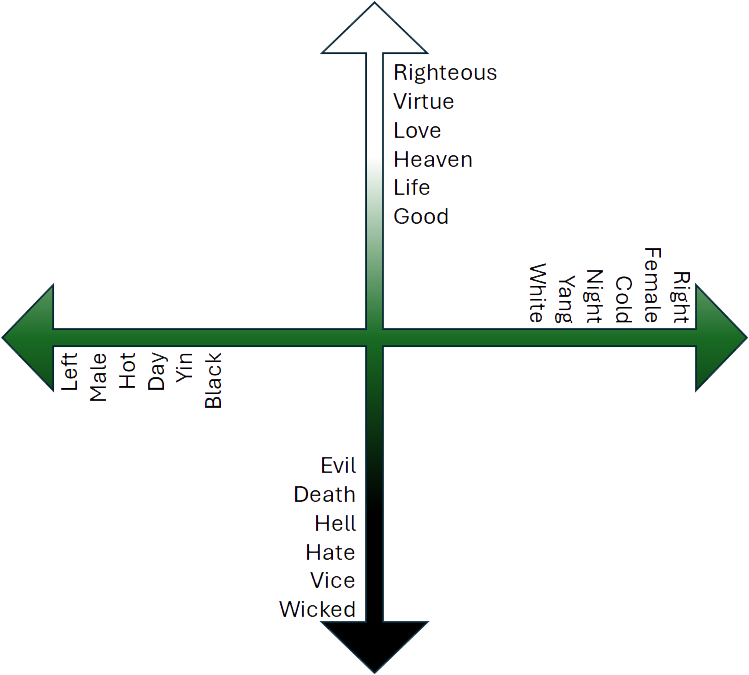
The principle of opposites or polarity describes that everything has an opposite on the same continuum. Good versus evil. Virtue and vice, light and darkness, health and sickness, pleasure and pain, bitter and sweet. Equal access. And with the agency from the previous principle you may choose.
This is balance in the law. Both options exist in objective opposition to one another. The poles exist whether or not anyone chooses. Polarity is the pre-condition for choice, not something that choice activates.
However, not every opposite is on a moral scale weighing good and evil. There are neutral opposites: hot and cold, male and female, up and down, left and right, day and night, rest and work, positive and negative, yin and yang. Growth comes from accepting the tension between opposing forces, learning from the successes and failures of life rather than clinging to one and resisting the other. Holding opposites in balance increases perspective, reduces our own internal struggle, and helps us develop greater self awareness.
The Kabbalah calls this the Law of Polarity.
He invites everyone to come to Him and share in His goodness and doesn’t deny anyone who comes to Him, black or white, enslaved or free, male or female; and He remembers those who don’t worship Him or know anything about Him.
Did you catch that call out to polar opposites along the morally neutral scale? Awesome, right?
Justice
I know everyone chooses between good and evil; however, those who can’t tell good from evil are innocent, but everyone who understands the difference between good and evil will get to experience, based on their choice, either good or evil, life or death, joy or regret.
Alma 15:12
Although there are neutral opposites it is important to recognize which spectrum we are on. Calling evil good collapses the scale and creates confusion for people in what ought to be a clear moral distinction.
Woe unto them that call evil good and good evil, that put darkness for light and light for darkness, that put bitter for sweet and sweet for bitter.
Isaiah 1:17
Any and all commandments seat comfortably under the law of justice. Commandments orient people towards the direction worth choosing; the light the good, and life. Here’s what you should do.
Commandment
Thou shalt not…
So the Lord God has commanded everyone…
Doctrine
I also testify the Father commands all people everywhere to…
Inside of any commandment is the option to choose God’s light over darkness. Commandments, if kept, align to the economy of light. The opposite of that are temptations that if succumbed to enter the economy of darkness.
People are instructed well enough to understand good from evil — the law is given to mankind. However, no one on earth is justified by the law — that is, mankind are cut off by the law, indeed, they were cut off by the earthly, temporal law. Likewise, they’re shut out from good things by the spiritual law and become miserable forever.
Mercy - Sacrifice
This is because redemption comes in and through the Holy Messiah, because He is full of grace and truth. He offers Himself as a sacrifice for sin, to fulfill the requirements of the law for all those who have a broken heart and a contrite spirit. Therefore the requirements of the law cannot be met for anyone else.
2 Nephi 1:6
For the principle of Mercy let me start with the underlying law which is Sacrifice. There is an energy exchange that happens according to the law of sacrifice and the effect of that transaction along the horizontal scale doesn’t care about consent. Much like a flashlight doesn’t care if the battery volunteered for the job. However, on the good/evil moral scale of justice, consent is everything. I’ll leave non-consenting sacrifice alone because it is equivalent in magnitude and opposite in horror to the willing sacrifice of our Lord in laying down His life for our salvation.
Mercy acts within a justice-claim, not against it. In cases where the claimant decides, “the debt is gone, never mind” it suggests that the standard was never real; deciding retroactively that the injustice never mattered to begin with. Cheap mercy spares the offending debtor by cheapening the offense. I imagine this would look like waiving parking tickets or library fines.
…for the wages of sin is death…
—Romans 6:23What? Do you imagine mercy can rob justice? I tell you: No, not at all. If so, God would stop being God.
—Alma 19:16 CoC
Justice must be paid. And we simply aren’t capable of paying the debt. So Christ interceded on our behalf, paying an infinite and eternal debt that was not owed in order to extend Mercy.
However, God’s mercy requires repentance on our part allowing access to the forgiveness that is offered. Baptism is a “sign of repentance”. It is symbolically laying down the man of sin in death —willingly sacrificing oneself—and rising a new creature in Christ.
God’s mercy has the eternal purchasing power to satisfy the demands of Justice; the ability to pull someone out of the Economy of Darkness and cross back into the Economy of Light.
Again, the law behind the principle of Mercy is sacrifice
Now the plan of mercy couldn’t be brought about unless an atonement were made. Therefore God Himself will atone for the sins of the world, to bring about the plan of mercy, to meet the demands of justice, so that God can be a perfectly just God, and a merciful God as well.
Alma 19:14And His tender mercy is offered to all the earth.
Alma 14:21
Commandment
And exactly as I’ve commanded you, so you must baptize. You must not argue about this as you’ve done before, and you must not argue about the points of My doctrine either, as you’ve done before.
3 Nephi 5:8
I’ll pause here and let you know, when searching for the commandment to be baptized, I couldn’t find one. Not issued by God directly. There is one example of Paul commanding people to be baptized in the name of the Lord, but that’s as close as I could find.
A close second is “must repent and be baptized”. I think the close proximity to “must” is why we have accepted this idea that baptism is a commandment. The distance leaves room for it to still be an invitation.
However, there is no “must be baptized” or “command you to be baptized” anywhere. Go ahead and look. It’s not there.
Don’t get me wrong! Baptism is absolutely required to be saved and inherit God’s kingdom. Baptism is absolutely needed to fulfill all righteousness.
The Lord commands servants TO baptize. He commands HOW to baptize. But there’s not a commandment to BE baptized. That seems to only ever be an INVITATION.
Why not a commandment? Well, I think because if it was a commandment to be baptized there would also be a punishment affixed. And the self sacrifice wouldn’t be willing anymore. It would be compulsory. You cannot punish someone for declining to make a covenant without destroying the agency that makes that covenant meaningful.
For those who don’t belong to the congregation, I invite and ask you to come and be baptized as a sign of repentance, so you can also eat the fruit of the tree of life.
Alma 3:12Invite those who will repent to be baptized and forgiven, and they shall obtain my spirit to guide them.
T&C 157:65
Doctrine
And anyone who believes in Me and is baptized will be saved…
Again, look at the language here. “Will be saved” is a promise, not a threat. Therefore, any punishment we receive as a result rejecting mercy will be merited.
The first half of the chiasmus is God descending to man. The second half of the chiasmus is man ascending to God.
Ordinances
At this center point let me talk about the ordinances that link each side within the chiasmus
The ordinances are helps, symbols and requirements. Helps in that they establish milestones that memorialize passage from one stage of development to the next. Symbols in that they point to a deeper meaning or spiritual reality almost always grounded in the atonement of Jesus Christ. Requirements in that they mark the defined route taken by Christ as a mortal to fulfill all righteousness. The ordinances as symbols point to the real thing. The real thing is Jesus Christ and His Gospel.
Glossary: Ordinance
Baptism (Mercy-Hope)
Dispensation Covenant (Justice-Judgement)
Ordain to Priesthood/Women’s Council (Opposites – Order)
Sacrament (Agency-Faith)
Laying on of Hands for the Gift of the Holy Ghost (Truth-Intelligence)
Marriage (Love-Glory)
Hope
The principle of Hope explains that everything operates in cycles: day/night, the moon, seasons, rhythm – nothing is permanent but we can depend with absolute certainty that God’s promises will be realized. In the meantime energy is always in motion and changing forms.
It is hope which is powerful, controlling, and causes a thing to come to pass because it is now their right to receive the thing promised. God has conferred that right upon them. Hope is more than a wish, as it requires one to secure a promise from God. It requires one to be at rest — secure in the knowledge the Lord has promised a glorious resurrection. Hope is waiting for the time of the Lord’s promise to be fulfilled.
–Glossary: HopeTo everything there is a season, and a time to every purpose under the heaven: a time to be born, and a time to die; a time to plant, and a time to pluck up that which is planted; a time to kill, and a time to heal; a time to break down, and a time to build up; a time to weep, and a time to laugh; a time to mourn, and a time to dance; a time to cast away stones, and a time to gather stones together; a time to embrace, and a time to refrain from embracing; a time to get, and a time to lose; a time to keep, and a time to cast away; a time to rend, and a time to sew; a time to keep silence, and a time to speak; a time to love, and a time to hate; a time of war, and a time of peace.
–Eccles. 3:1-8
There’s a time appointed when all will rise from the dead. When this time might happen, no one knows; but God knows the time it’s appointed to take place. […] When the time comes when everyone rises, then they will know God planned all the times selected for mankind.
—Alma 19 CoC
Hope sits in the chiasmus with Mercy. We have Hope because of Mercy. And along with that is an expectation and commandment that we will forgive because we’ve been forgiven.
Commandment
I have given you a former commandment that I, the Lord, will forgive whom I will forgive, but of you it is required to forgive all men.
Judgement
The principle of Judgement is also known as the law of the Harvest; meaning you reap what you sow. Whether good or bad, our thoughts and actions have consequences and will be returned back to us in some form. What you give comes back. Hinduism, Buddhism, and Jainism call this the Law of Karma. Newton describes this as, “For every action there is an equal but opposite reaction.”
Be not deceived, God is not mocked; for whatever a man sows, that shall he also reap. For he that sows to his flesh shall of the flesh reap corruption, but he that sows to the spirit shall of the spirit reap life everlasting.
–Gal. 6:7-11
Judgement sits in the chiasmus with Justice. It’s the consequence that follows when one has interacted with the Law. Either for blessing or cursing, judgment naturally follows.
An obvious commandment that pairs with this principle is to not reap what you have not sown. Don’t steal take someone else’s stuff. Not their belongings, not their harvest, not their animals, not their intellectual property.
However, even without intentionally stealing we do reap what we have not sown. Keeping the Sabbath is a weekly acknowledgment that the much of the harvest you enjoy is given freely as a gift beyond your own effort by loving Parents.
Commandment
Thou shalt not steal
Remember the Sabbath day, to keep it holy. Six days shalt thou labor and do all thy work; but the seventh day, the Sabbath of the Lord thy God, thou shalt not do any work, thou, nor thy son, nor thy daughter, thy manservant nor thy maidservant, nor thy cattle, nor thy stranger that is within thy gates. For in six days the Lord made Heaven, and earth, and the sea, and all that in them is; wherefore, the Lord blessed the Sabbath day and hallowed it.
God’s rest followed the work of creation; the sowing. Adam and Eve lived in the Garden peacefully picking fruit that God had planted. Again, the Sabbath is the weekly acknowledgement that we alone are not the source of all the blessings, prosperity, and increase that we enjoy.
Law
There is a law, irrevocably decreed in heaven before the foundations of this world, upon which all blessings are predicated—And when we obtain any blessing from God, it is by obedience to that law upon which it is predicated.
For instead of blessings, you, by your own works, bring cursings, wrath, indignation, and judgments upon your own heads, by your follies and by all your abominations which you practice before me, says the Lord.
T&C 141:14
Order

You’ve heard it said that God’s house is a house of order. That’s far more than being organized. It defines: patterns, structure, the laws of nature. As above, so below.
God’s house is a house of order, but that does not mean what many people think it means. God follows patterns. He establishes and ordains things according to one pattern and then takes them down again according to another. He does not vary.
—Glossary – House of Order
Within the principle of order exist the laws of nature, the constants of math and science (π, e, φ), the structure of marriage, family, the Holy Order, authority, and stewardship.
The Lord said, Marriage was, in the beginning, between one man and one woman, and was intended to remain so for the sons of Adam and the daughters of Eve, that they may multiply and replenish the earth.
–T&C 175:23
Never has there ever, nor will there ever be… a child conceived without both a mother and a father. Such is the natural order of conception. Despite all the progressive declarations of inclusivity and tolerance —the laws of nature will be obeyed.
Beyond what is, consider what should be. Marriage ought to be lifelong and faithful, worth extending into eternity. Children ought to honor their parents.
Commandment
Honor thy father and thy mother, that thy days may be long upon the land which the Lord thy God giveth thee.
Thou shalt not commit adultery.


Faith - Power
Thought sets the intention. Action gets the result.
Faith crosses the boundary from the spiritual realm into the physical. Thoughts spoken, for example:
God spake, chaos heard, and worlds came into order by reason of the faith there was in him.
—Lectures on Faith 1:22
Speaking words aloud turns thoughts into vibrations that interact with the physical world. These can be measured, recorded, heard by others who may move into action depending on what was communicated.
The same applies to writing something down. You are organizing intangible thoughts into a physical form that others can read, sometimes thousands of years after the fact.
But faith is not only the principle of action, but of power also, in all intelligent beings, whether in Heaven, or on earth.
—Lectures on Faith 1:13
Consider that a city skyscraper is designed entirely within the mind and then on paper before ground is ever broken for construction.
Faith sits within the chiasmus with Agency.
Action taken based on unbelief has no result because it isn’t aligned with reality. Waving a “magic wand” over the pumpkin seeds on my dresser will not, for example, turn them into apple trees.
Law
There is a law, irrevocably decreed in heaven before the foundations of this world, upon which all blessings are predicated—And when we obtain any blessing from God, it is by obedience to that law upon which it is predicated.”
Intelligence - Light of Truth
Intelligence is the light of truth and everything is relative.
Intelligence, or the light of truth, was not created or made, neither indeed can be.
—Teachings & Commandments 93:10
Energy cannot be created nor destroyed. In science this is called the First law of thermodynamics = conservation of energy
…if there be two spirits and one shall be more intelligent than the other, yet these two spirits — notwithstanding one is more intelligent than the other — yet they have no beginning (they existed before), they shall have no end (they shall exist after), for they are gnolaum, or eternal. And the Lord said unto me, These two facts do exist — that there are two spirits, one being more intelligent than the other; there shall be another more intelligent than they. I am the Lord, your God; I am more intelligent than they all.
–Abraham 5:4
Intelligence sits in the chiasmus with Truth.
Law
“Whatever principle of intelligence we attain unto in this life, it will rise with us in the resurrection. And if a person gains more knowledge and intelligence in this life through his diligence and obedience than another, he will have so much the advantage in the world to come.
Glory
Glory is the resulting state of being when light embodied and retained.
God says this is His work and [His] glory: to bring to pass the immortality and eternal life of man (Genesis 1:7) — that mankind returns to His presence and with Him partakes of eternal life and exaltation. Since His glory is intelligence, He shares it with us. Glory is shared intelligence.
Glory sits in the chiasmus with Love. God is love. The glory of God is intelligence. This is His work and His glory, to bring to pass the immortality and eternal life of man. God’s glory is expressed through our advancement.
Law
The first principles of man are self-existent with God. God himself, finding he was in the midst of spirits and glory, because he was more intelligent, saw proper to institute laws whereby the rest could have a privilege to advance like himself. The relationship we have with God places us in a situation to advance in knowledge. He has power to institute laws to instruct the weaker intelligences, that they may be exalted with Himself, so that they might have one glory upon another, and all that knowledge, power, glory, and intelligence, which is requisite in order to save them in the world of spirits. (DHC 6: 312.)
From the Canon/Archives
I shared this list previously. Now having fleshed out the above structure I have color coded according to the associated principle(s).
Principles of
- …godliness (Glossary: Plan of Salvation)

- …righteousness (T&C 139:4-5, LoF 4:17)

- … the gospel (Glossary)


- … the doctrine of Christ (Hebrews 1:14)
- …exaltation (Glossary: Jacob’s Ladder)
- …this society (Lectures on Faith Preface)
- … freedom (T&C 98:2)
- … the law of the Celestial Kingdom (T&C 107:1)
- … law and humanity (T&C 146:18)
- …the oracles of God (Hebrews 1:14)
- …astronomy (Facsimile 3 From the Book of Abraham)
- …truth (PTHG p. 246)
- …eternal life (TTODCS Vol 1 p. 72)
- …the Constitution (Testimony of Jesus, p. 31)
- …Biblical Hermeneutics
- …republican government (TTODCS Vol 1 p. 294)
- …sacrifice (TSC p. 196)
- …Zion (TTODCS p. 144)
- …religion (Equality p.2)
- …sin and forgiveness (Blogpost)
Principle of
- … faith (LoF 1:16, 2:2)
- … power (LoF 1:15, 1:17, 1:19, 1:34. 1:35, 1:36)
- … action (LoF 1:9, 1:13, 1:29-1:31, 1:33, 7:2)
- …decision-making (Glossary)
- …asking and receiving (Glossary)
- … intelligence (Glossary: Intelligence/s)
- … (continuing) revelation (Glossary)
- … “other sheep” (TSC p. 98)
- … the keys of the kingdom
- … opposition
- … mercy
- … tithing
- … daily effort and on-going devotion
- …common consent
- … Christian healing (Testimony of Jesus p. 258)
- …interpretation
- …the Second Comforter
“One of the grand fundamental principles of Mormonism is to receive truth, let it come from whence it may.” (Discourses of Joseph Smith, p. 199)
I recognize that justice, hope, justice, order and glory aren’t explicitly mentioned as principles. Therefore, I can’t confidently claim that I have figured out all the principle mysteries of the universe.
For now, this structure makes sense to me and I welcome further light and knowledge.
In any case, I do think we’re making some progress.