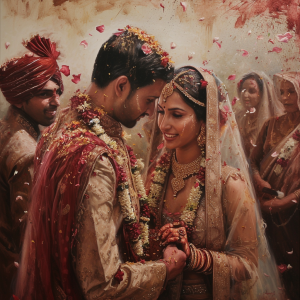
In Hinduism, marriage is referred to as “Vivaha” or “Vivah.” Vivaha is a sacred and significant institution, and Hindu marriages are considered not only a social and legal contract but also a sacrament. Hindu marriage is a union of two individuals as a lifelong commitment.
The marriage ceremony is a complex and ritualistic event, involving various traditions and customs. It includes rituals such as the exchange of vows, the chanting of sacred mantras, the taking of the seven steps around the sacred fire (Saptapadi), and the application of sindoor (vermilion) on the bride’s forehead by the groom.
The Hindu scriptures, including the Vedas and Smritis, provide guidance on the principles and rituals associated with marriage. The concept of marriage is deeply embedded in the broader framework of Hindu philosophy, emphasizing the importance of dharma (moral and social duty), artha (material prosperity), and kama (sensual and emotional fulfillment). The marital relationship is also seen as a means of spiritual growth and mutual support in the journey of life.
Saptapadi, also known as the Seven Vows or Seven Steps, is a significant ritual in Hindu marriage ceremonies. It symbolizes the mutual promises and commitments made by the bride and groom to each other. The ceremony involves taking seven steps together around the sacred fire (Agni), and with each step, the couple expresses their aspirations and pledges for their married life.
The Seven Vows
The Seven Vows are traditionally recited in Sanskrit, and their meanings may vary slightly based on regional and cultural variations. Generally, the vows encompass a range of commitments, including love, understanding, companionship, loyalty, and shared responsibilities. Here is a common representation of the Seven Vows:
First Step (Prathamam Vakshyami): The first step is a commitment to nourish each other physically, mentally, and spiritually. The couple vows to provide for and support one another in all aspects of life.
Second Step (Dvitiyam Vakshyami): The second step signifies the importance of strength and stability in the relationship. The couple promises to be each other’s strength and to overcome challenges together.
Third Step (Tritiyam Vakshyami): The third step emphasizes the role of wealth and prosperity in their life. The couple commits to working together to acquire wealth, manage their finances responsibly, and share their prosperity with others.
Fourth Step (Chaturtham Vakshyami): The fourth step signifies the pursuit of happiness and the development of a harmonious relationship. The couple vows to find joy and peace in their shared life.
Fifth Step (Panchamam Vakshyami): The fifth step represents the couple’s commitment to the welfare of their future children. They promise to provide a loving and nurturing environment for their children, ensuring their well-being and education.
Sixth Step (Shashtam Vakshyami): The sixth step is a commitment to self-control and longevity. The couple pledges to maintain self-discipline, remain faithful to each other, and live a long and healthy life together.
Seventh Step (Saptamam Vakshyami): The seventh and final step symbolizes the couple’s promise to remain lifelong friends and companions. They vow to be true partners, sharing each other’s joys and sorrows, and to always be there for one another.
After completing the Seven Steps, the marriage is considered complete, and the couple is officially united as husband and wife. The Saptapadi ceremony is a beautiful and symbolic tradition that underscores the depth of commitment and mutual understanding in Hindu marriages.
Reading from the Vedas
Rig Veda, Mandala 10, Hymn 85 – Hymn of the Cosmic Being. Verses metaphorically express the interconnectedness of various aspects of creation, symbolizing the union of a married couple. Verse 30 is often cited in the context of marriage. It speaks metaphorically about the bridegroom being the Purusha (cosmic being) and the bride being the Viraj (cosmic woman).
27. Happy be thou and prosper with thy children here: be vigilant to rule thy household in this home.
Closely unite thy body with this; man, thy lord. So shall ye, full of years, address your company.
28. Her hue is blue and red: the fiend who clingeth close is driven off.
Well thrive the kinsmen of this bride the husband is bound fast in bonds.
29. Give thou the woollen robe away: deal treasure to the Brahman priests.
This female fiend hath got her feet, and as a wife attends her lord.
30. Unlovely is his body when it glistens with this wicked fiend,
What time the husband wraps about his limbs the garment of his wife.
31. Consumptions, from her people, which follow the bride’s resplendent train,-
These let the Holy Gods again bear to the place from which they came.
32. Let not the highway thieves who lie in ambush find the wedded pair.
By pleasant ways let them escape the danger, and let foes depart.
33. Signs of good fortune mark the bride come all of you and look at her.
Wish her prosperity, and then return unto your homes again.
Rigveda Mandala 10, Hymn 159; dedicated to the marital union, expressing the joy of a bride and groom coming together. It includes blessings for the couple and their future together.
1. YON Sun hath mounted up, and this my happy fate hate mounted high.
I knowing this, as conqueror have won my husband for mine own.
2. I am the banner and the head, a mighty arbitress am I:
I am victorious, and my Lord shall be submissive to my will.
3. My Sons are slayers of the foe, my Daughter is a ruling Queen:
I am victorious: o’er my Lord my song of triumph is supreme.
4. Oblation, that which Indra gave and thus grew glorious and most high,-
This have I offered, O ye Gods, and rid me of each rival wife.
5. Destroyer of the rival wife, Sole Spouse, victorious, conqueror,
The others’ glory have I seized as ’twere the wealth of weaker Dames.
6. I have subdued as conqueror these rivals, these my fellow-wives,
That I may hold imperial sway over this Hero and the folk.
Applying Sindoor
Sindooor or vermilion holds special significance in Indian society. The application of sindoor in the parting of hair by married Hindu women is considered to be auspicious (an invitation for prosperity and blessings) and has been carried on for centuries.
In traditional Hindu society, wearing sindoor is considered must for married Hindu women. It is a visible expression of their desire for their husbands’ longevity. Traditionally therefore, widows do not wear vermilion.
According to Hindu astrology, Mesha Rashi or the House of Aries is on the forehead. The Lord of Mesha is Mars and his color is red. This is why red sindoor is applied at the forehead and at the parting of the hair. Both are signs of saubhagya (good fortune). Sindoor is also considered to be the symbol of the female energy of Parvati (Sati), the goddess consort of the deity Shiva, god of fire and transformation.