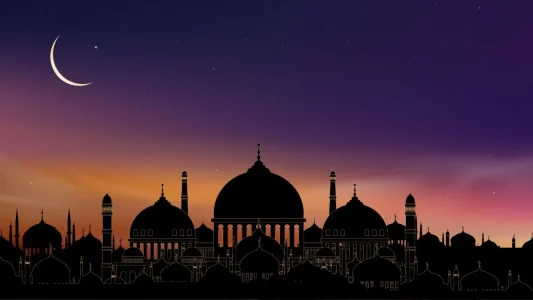
Ramadan is an annual month-long fast to remember of the origins of Islam. In the ninth month of the Islamic calendar the first revelations of the Qur’an were revealed to the Prophet Muhammad by the angel Jibreel (Gabriel) in the year 610 CE, an event known as Laylat al-Qadr (the Night of Decree or Power).
The exact date of Ramadan always depends on the sighting of the crescent moon. This year Ramadan begins on March 1st and ends around March 29th.
Those who fast during Ramadan abstain from food, drink and marital relations from sunrise to sunset every day during Ramadan.

History
At the age of forty, Muhammad began seeking solitude to reflect on questions that weighed heavily on his heart. He began retreating to a cave on Mount al-Ḥirā, spending long periods in contemplation, often a month at a time.
In the year 610 CE, during one of these retreats, an extraordinary event occurred. While alone in the cave, Muhammad was visited by the archangel Gabriel. The angel instructed him to “read.” Overcome with fear and confusion, Muhammad responded that he did not know how to read. This command was repeated twice more before Muhammad finally asked what he was supposed to recite.
Gabriel then revealed the first verses of what would become the Qur’an:
“Proclaim! in the name of thy Lord and Cherisher, Who
Created man, out of a clot of congealed blood:
Proclaim! And thy Lord is Most Bountiful,–
Who taught by the pen–
Taught man that which he knew not.”
Following this angelic encounter, Gabriel declared, “Thou art the messenger of God, and I am Gabriel.” Muhammad fled the cave, initially believing he might have encountered an evil spirit. He ran down the mountainside, and as he did, the angel, Gabriel, appeared in its true form in the sky above him, filling the entire sky, which had become green, which, incidentally, is where Islam gains its official color.

Upon returning home, Muhammad confided in his family about the event. Seeking guidance, he consulted a devout Christian relative, who affirmed that Muhammad had indeed been chosen as a prophet of God.
Not long after this experience, Muhammad began to receive further revelations from Gabriel, along with insights that stirred within his own heart. According to hadith—narratives about Muhammad’s life written 150 to 250 years after his death in 632 AD—it is believed that all holy scriptures were revealed during the month of Ramadan, establishing this period as the most sacred and revered time in the Islamic faith.
Observation
Fasting during Ramadan is not just a tradition—it is a religious obligation outlined in the Qur’an. The requirement is found in Surah Al-Baqarah (2:183-185):
O YOU who have attained to faith! Fasting is ordained for you as it was ordained for those before you, so that you might remain conscious of God (2:183)
It was the month of Ramadan in which the Qur’an was [first] bestowed from on high as a guidance unto man and a self-evident proof of that guidance, and as the standard by which to discern the true from the false. Hence, whoever of you lives to see this month shall fast throughout it; but he that is ill, or on a journey, [shall fast instead for the same] number of other days. God wills that you shall have ease, and does not will you to suffer hardship; but [He desires] that you complete the number [of days required], and that you extol God for His having guided you aright, and that you render your thanks [unto Him] (2:185)
These verses make it clear that fasting during Ramadan is a divinely mandated practice, not merely a cultural tradition. However, the Qur’an also acknowledges exceptions — for example, those who are ill, elderly, pregnant, or traveling are permitted to abstain, with the expectation that they either make up the days later or provide a charitable substitute (fidya).
In addition to fasting from dawn to sunset, Muslims spend more time in prayer, recitation of the Qur’an, and engaging in charitable acts. The spiritual goal is to practice self-discipline, grow closer to God, and cultivate empathy for those less fortunate.
For the entire month, Muslims refrain from eating while the sun is shining, with the exception of pregnant women, young children who have not yet reached puberty, nursing mothers, travelers, those who are elderly, sick, those with physical or mental illness, or have any other condition which might preclude fasting.
This fasting must be done in faith; intentional. Niyyah (faith) is an Islamic concept that refers to the intention in one’s heart to do an act for the sake of God (Allah). It is a prerequisite for performing any form of Ibadah (worship) and good deed. The niyyah should be to get closer to Allah. It is the reason and intent behind every action.The concept of niyyah guides the fasting of Ramadan. Muslims must willfully dedicate their fast to Allah alone in order to achieve niyyah (faith).
During Ramadan, many families may recite one thirtieth of the Quran in a special nightly prayer so that the entire book will be read by the end of the month.
Mosques may hold Iftars, or dinners to break the fast nightly during Ramadan that are open to the wider community. Families and friends may also hold Iftars at home. Mosques may also hold open houses and food drives during the holy month.
Ramadan Ends
The day after Ramadan ends starts one of the major holidays in the Islamic calendar: Eid Al-Fitr, or the Festival of Breaking the Fast, a three-day festival that will start at the next sighting of the crescent moon.
The holiday is celebrated with special prayers, desserts, presents for children and community festivals.