The Old Testament: Burning Fat as a Sacred Offering
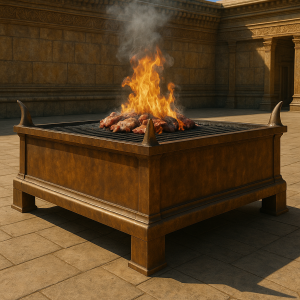
Throughout the Old Testament, God gave specific instructions regarding sacrifices, particularly what was to be done with the fat of the animals. Fat was considered the richest, most potent part of the offering—and it was not supposed to be eaten. Instead, it was to be entirely burned on the altar as an offering exclusively for the Lord.
Consider these passages:
And the priest shall burn them upon the altar. It is the food of the offering made by fire for a sweet savor. All the fat is the Lord’s.
Lev. 3:12-17And he shall take off from it all the fat of the bullock for the sin offering: the fat that covers the entrails, and all the fat that is upon the entrails, and the two kidneys, and the fat that is upon them, which is by the flanks, and the lobe above the liver with the kidneys; it shall he take away, as it was taken off from the bullock of the sacrifice of peace offerings. And the priest shall burn them upon the altar of the burnt offering.
Lev. 4:1-12“You shall eat no manner of fat of ox, or of sheep, or of goat…. for whoever eats the fat of the beast of which men offer an offering made by fire unto the Lord, even the soul that eats it shall be cut off from his people.
Lev. 7:22-27
In every case, the fat—the symbol of strength, abundance, and vitality—was set aside to be burned. It represented giving God the very best part, the richest offering, the essence of vitality itself.
The rising smoke of burning fat was called a “sweet savor“ to the Lord—an act of love, obedience, and worship.
Our Bodies: The Living Temples
The New Testament brings this symbolism even closer to home:
“What? know ye not that your body is the temple of the Holy Ghost which is in you…? Therefore glorify God in your body, and in your spirit, which are God’s.
1 Corinthians 6:19–20
We no longer sacrifice animals on the temple altar, but we ourselves are called to be living temples, holy and set apart for the Lord.
When we fast, we invite the ancient pattern of sacrifice into our personal, living sanctuaries.
Since Christ came to fulfill the law the practice of animal sacrifice was done away with. Now what we’re to offer is a broken heart and a contrite spirit. How is this to be done?
Indeed, God has given us a test worthy of a God. And only those worthy of becoming among the gods will be able to solve the riddle. Because only they will humble themselves, come with a contrite spirit and broken heart to offer upon the altar a sacrifice worthy of being accepted.
2 Nephi 31: 16 — Denver Snuffer
Biological Response to a Broken Heart and Contrite Spirit
When someone is really, deeply sad — especially in cases of grief, heartbreak, or depression — the hypothalamus, which helps regulate hunger, is disrupted. Here’s what happens:
Stress hormones, especially cortisol, rise.
Serotonin and dopamine — the “feel good” neurotransmitters — drop.
The brain’s appetite signals get suppressed, especially in the part of the brain that would normally say “eat to feel better.”
Additionally, sadness can activate the parasympathetic nervous system, which can slow down digestion and even cause nausea, making food seem unappealing.
It’s the body’s way of saying: Pause. Be still. Something inside needs attention.
But look at this man whose heart was broken on this day. He cried out. “Lord I believe help thou mine unbelief.” [You have a desire, you have the willingness, but it is so fragile! It is so frail that you don’t think it’s enough! That’s not the problem. Cry out! Ask him!]
Remember His disciples who had been following Him, who were His faithful followers, those disciples couldn’t fix this boy. Those disciples had given up everything to come and follow Him. They knew much more than this man. But their knowledge did them no good. Jesus healed the boy. After the incident the disciples came to Him and said, “Why could we not cast him out?” Christ answered them and said, “This kind can come forth by nothing, but by prayer and fasting.”
Why do you have to be afflicted by prayer and fasting, if you’re a follower of the Lord, in order to get to the point you can accomplish this? Because you don’t fall prostate, crying out with tears from a broken heart and a contrite spirit. If this man, in this condition, can say, “I believe, help thou mine unbelief.” If this man can do this and have the Lord on his behalf work a miracle, you too can believe enough, you too can accomplish what you desire, you too can come to Him.
The Science of Fasting: Entering Ketosis
Science shows that when we fast for a sufficient period, our bodies shift from burning sugar (glucose) to burning fat for fuel. This process is called ketosis.
Here’s how it happens:
In the first 12–18 hours of fasting, glucose stores are depleted.
The body, seeking energy, turns to stored fat.
Fat molecules are broken down into ketones, which fuel the body and mind with clean, efficient energy.
Our bodies are the temple, and our fasting becomes the fat offering demonstrating a broken heart and contrite spirit. Fasting literally burns fat within our bodies. It burns away excess, refines us, and strengthens our health—all while echoing the ancient command: “The fat belongs to the Lord.”
Every ketone your body produces during a fast is a symbol: the fire of sacrifice has been rekindled—not on an external altar, but deep within you.
Fasting as a Spiritual Renewal
Fasting is not merely abstaining from food. It is a sacred ritual of offering, purification, and transformation.
We offer our cravings, strength, and hidden abundance to God.
We humble ourselves, recognizing that true sustenance comes from Him.
We create a sweet aroma of sacrifice in His sight—not from burning animals, but from burning away pride, excess, and dependence on the material.
As we fast, we are participating in a pattern as old as the Temple itself: We are laying the richest parts of ourselves on the altar and letting the holy fire consume them.