
SIGNATURE SERIES: Study In Goodness, Nature, Archetypes, & Truth; Unveiling Righteousness & Eternity
Read this first: Fundamental Truths in Fairy Tales, Fables, and Legends
Themes: Mother, see The Mother – Face Toward Zion
Source: Nursery Rhymes, France
I
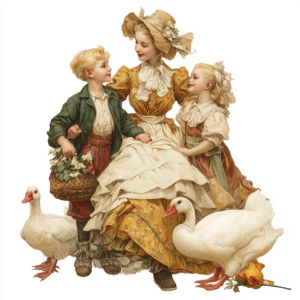
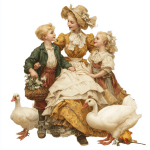
Old Mother Goose,
When she wanted to wander,
Would ride through the air
On a very fine gander.
Mother Goose had a house,
Twas built in a wood,
Where an owl at the door
For sentinel stood.
This is her so Jack,
A plain-looking lad;
He is not very good,
She sent him to market,
A live goose he bought,
“Here, Mother,” says he,
“It will not go for nought.”
Jack’s goose and her gander
Grew very fond;
They’d both eat together,
Or swim in one pond.
Jack found one morning,
As I have been told,
His goose laid him
An egg of pure gold.
Jack rode to his mother,
The news for to tell,
She called him a good boy,
And said it was well.
Jack sold his gold egg
To a rogue of a Jew,
Who cheated him out of
The half of his due.
Then Jack went a-courting
A lady so gay,
As fair as the lily,
And sweet as the May.
The Jew and the Squire
Came behind his back,
And began to belabour
The sides of poor Jack.
Then old Mother Goose
That instant came in,
And turned her son Jack
Into famed Harlequin.
She then, with her wand,
Touched the lady so fine,
And turned her at once
Into sweet Columbine.
The gold egg into the sea
Was thrown then—
When Jack jumped in,
And got the egg back again.
The Jew got the goose,
Which he vowed he would kill.
Resolving at once
His pockets to fill.
Jack’s Mother came in,
And caught the goose soon,
And, mounting its back,
Flew up to the moon.
The gander goose is a bird of great strength and power. The Native Americans saw this assertive creature as a symbol of masculinity. The gander was also seen as a protector of his family and territory. Finally, he was considered to be a brave bird that would defend his own against all odds. The gander goose meaning and symbolism can be interpreted in many ways, but the overall message is one of strength, power, and protection.
Wisdom and Knowledge: Owls are universally recognized as symbols of wisdom. This association dates back to ancient Greece, where the owl was linked to Athena, the goddess of wisdom. Owls represent insight, knowledge, and the pursuit of truth, urging individuals to trust their intuition and seek deeper understanding in life.
The golden egg symbolizes fertility, creation, transformation, prosperity, and new beginnings across various spiritual beliefs. In many cultures, it represents the beginning of a new cycle, embodying the promise of growth and renewal.
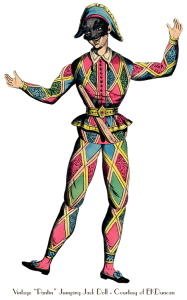
The Harlequin character embodies themes of social class and the dynamics between the rich and the poor. His antics often reflect the struggles of the lower class, making him a relatable figure for audiences.
The term “squire” historically refers to a shield bearer or armor bearer of a knight. In a broader context, it can also denote a young nobleman who served as an apprentice to a knight or a local dignitary. In modern usage, “squire” is often used informally to refer to a gentleman or a local official.
The Columbine flower, scientifically known as Aquilegia, holds significant meaning across various cultures.
In Greek and Roman mythology, it is associated with the goddess of love, Aphrodite, symbolizing beauty and desire, see Consort Archives – Face Toward Zion
Since Jack’s mother rode the goose up to the moon and we know that she originally rode the gander, the male goose, we can infer that the goose that the Jew vowed to kill was the gander and not his consort.
Then these Jews were even more angry at Jesus, and conspired to kill him because he had violated their traditions about the Sabbath and they feared he did every thing to undermine their authority. But Jesus corrected them saying, My Father works on every day including the Sabbath, and I follow his example. This convinced the Jews to be even more determined to kill Jesus, because he had both violated their traditions about the Sabbath, and claimed God was his Father, which would make him equal with God.
The moon symbolizes feminine energy contrasting with the sun’s masculine qualities, intuition, cycles of life, and emotional depth, reflecting its profound influence on human experiences and natural phenomena. This connection is reflected in various cultures where the moon is linked to goddesses and women’s cycles, symbolizing nurturing, intuition, and emotional strength.
Goose Symbolism Across Cultures
The goose has left its mark on human history, soaring through ancient stories and beliefs. Here’s how different cultures have interpreted its presence:
Ancient Egypt: Messengers of Truth
In the land of the pharaohs, geese were sacred to Ma’at, the goddess of truth, justice, and cosmic balance. Seen as her divine companions, these birds symbolized harmony and order. Egyptians believed geese carried messages of wisdom from Ma’at, guiding humanity toward a life aligned with fairness and integrity.
Norse Mythology: Creators and Protectors
Norse tales paint the goose as a celestial force. Legend has it that the first goose laid an egg that hatched the sun, birthing light into the world. To the Vikings, geese were sacred warriors of the sky—symbols of strength, courage, and protection. Heroes and shieldmaidens looked to them as emblems of resilience in the face of epic battles.
Chinese Culture: Harbingers of Luck
In China, the goose honks its way into folklore as a symbol of fidelity, loyalty, and prosperity. The sound of a goose’s call was thought to usher in good fortune, while its image often graced art celebrating family unity. Here, geese remind us of the power of togetherness and enduring bonds.
[source]
BONUS—Piddle Diddle and Wo
I
There once was a land
Full of mountains and sand
Where seeds were scattered to grow
The Goose and the Gander
Were found to meander
In fields and meadows below.
Atop seven hills
Where the water distills
From clouds into pure mountain streams
Was heard the stark cry:
“You must do or must die!”
For dragons are more than they seem
They cannot be trained
But will lie, just the same
And deceive by design in puff magic
They only drink blood
And cannot be loved
But will kill, maim, destroy most tragic
The king sent a rescue so angels could expect to
Reclaim those who were lost down below.
Mothers will name us; but our deeds, they can shame us
We are remembered by actions alone
And so onto our tale, while down in the vale
of Piddle, Diddle and Wo
There came to the sea
Brothers numbering three
Seeking unicorns trapped in the surf
There was plenty of time, to enjoy and sublime
But not to the point of distraction
Piddle did fiddle all his days in the middle
And found that he lost all he had
Diddle did dawdle with trinkets and baubles
Amassing naught ashes and dust
But Wo was more cautious and taught thus in office
A bridle he kept on the reins
He called from the rocks to those tempest and tossed
giving courage to step out onto land.
Still the dragon was there, bearded and bare
Mauling all who dare to defy her
So wounded they crawled over bones that were sprawled
Cross the sands that echoed through time
Wo, though was battered, remained in the hazard
and continued to call through the surf.
And when healed had gathered, again tempted and flattered
Casting dreams only dragons can promise.
Their clothes still were tattered, but what really mattered
Were the scars from battling for shore.
It made them much stronger and wise to the slaughter
should they harken to the voice of the whore.
They instead left the beach
with hope they would reach
Green pastures with clear mountain streams
Realizing that Piddle had been noncommittal
Diddle blamed his brother in arms.
But Piddle blamed Diddle and pled for acquittal
Too late, they were caught in the storms.
Neither one could undo,
nor had time to accrue
Oil. It had been burnt during daylight.
The path had been mapped
with no time to distract
For dragons have advantage of foresight.
She knows she is doomed, to be in fire consumed
If you hearken, a new name she’ll bestow
And so we now know each lost sibling below
By Piddle, Diddle, and Woe.
Woe not for the servant, his pleadings most fervent
But for those fearful who listened to her.
Yet, Wo was his name. Mother adds to his fame
with two letters, A.H, can you spell it?
For his patience and caution, for the hearts that were softened
He is Woah. War Horse, son of Shiloh

Where did this poem come from?
All I can say, is that in 2021, in the space between dreams and awake it was recited to me, multiple times over the course of several nights.
I can write. And I write well. But I don’t write poetry. It’s just not my thing.
This poem was originally posted on this website in the post Distraction & Repentance.




This Post Has One Comment
Posted in “That We Be One”, Adrian’s blog, Peace in Paradise, and TBM Blog and thought I would try to post here:
A follow up to ___’s “What the heck is going on here lately?!” post, I guess I’m wondering the same [because of how quiet it has been]. But, to make the question more specific, I’ve been thinking about the Mousetrap talk. I plan to listen to it again today.
On Dec 20, Denver said this was his most important talk and it would look different in a few months. Well, it’s been a few months. That was more or less the Winter solstice. We’re coming up on the Spring equinox. I’d say that qualifies as a few months, but I’m not sure the talk looks different to me. That’s why I want to re-listen.
I’m just wondering if it looks different to anyone else?
I’d love to pose that question more generally to the whole Covenant Christian body, but there doesn’t seem to be a good way to do that. I don’t have much visibility into these other places, wherever they are.
I can look on Adrian’s blog, but there hasn’t been much activity there. I know there’s a Slack space, but I think that’s only for the women. I think there’s an email thing, but I think that’s only for the women. I guess I can reach out to people individually, but I’m not sure where I would start and what the point would be.
So, I can pose the question here and I’m certainly interested in responses here. But, this is a pretty small sample size. The Covenant Christians don’t seem to be much of a body. More like disembodied parts. A hand here, a leg there, maybe an ear or a nose. But, not really a body.
I can’t help but feel a bit sad about this.